March 1, 2017
Films at this Year's Chicago European Film Fest Run from the Raucous to the Moody to the Heartfelt
Kevin Langson READ TIME: 10 MIN.
For twenty years now, Gene Siskel Film Center has been bringing a cornucopia of European cinema to Chicago via the Chicago European Union Film Festival (CEUFF), which is rich both in the major cinema nationalities, like the French, as well as Eastern European offerings that rarely get stateside screenings.
The Festival runs March 3 - 30 at the Gene Siskel Film Center of the School of the Art Institute of Chicago,164 N. State Street, Chicago, IL. For further information, visit the Siskel Film Center website.
This year big name French auteurs like Bruno Dumont ("Slack Bay,") Francois Ozon ("Frantz,") and Olivier Assayas ("Personal Shopper") have new offerings, as does the beloved Dardenne brothers ("The Unknown Girl.") The 62 features that comprise the festival encompass every state member of the European Union, with a commendably strong showing of gay cinema -- from the raucous, to the moody, to the heartfelt. Here are a few screened and appreciated by the writer. The festival runs March 3-30 at the Gene Siskel Film Center.
This year's festival brings two of the finest queer directors working today to Chicago. Francois Ozon and Joao Pedro Rodriguez are both essential queer/Euro auteurs who consistently provide antidotes to run-of-the-mill gay cinema. With characters that are alluringly brooding and narratives that challenge more than they console or entertain in any simple way, they bring something fresh and unconventional, though in ways that are quite distinct from one another.
Ozon is as prolific as he is difficult to pin down. In recent films, his protagonists have been a widower who dresses up in his deceased wife's clothes, a young bourgeois blonde girl lured into prostitution, and a teenage voyeur/writer who spies on this friend's family to intrigue his English teacher. Ozon often delves into (sometimes sordid) sexual matters, but his characters are not always gay. Still, there is some thread of gay sensibility that runs giddily if discreetly through is work.
"Frantz," his latest, is one of his more elegant pieces. Set in a German village and mostly in black and white, though unpredictably shifting to colour, the period piece's intrigue begins when a widow in mourning sees a stranger placing flowers on the grave of her husband who was killed in World War I combat. His soon-discovered French-ness makes him suspect, but his good luck and politeness have an effect on the widow and her in-laws who house her. The French visitor ingratiates himself and waxes nostalgic about his time with the deceased soldier as a gracious dinner guest, assuaging the fresh despair even of the father who is initially loath to allow in a Frenchman. And It is easy to imagine a love affair between these two soldiers -- the intense mourning that seems to exceed what men normally allow for friends, the elated visits to the Louvre, the father's wariness. However, things are not what they seem, and the narrative carries on in unexpected directions, touching on the toll taken by war on psyche of a populace and the role of truth in healing. ("Frantz" screens in the Festival on March 19 and 23.)
Portuguese director Rodriguez may be the most abstruse of queer European auteurs; his films feel vital in their peculiarity and beauty. He takes gay men out of clubs and cafes and places them on garbage trucks and on scientific expeditions in mountainous landscapes. The protagonist of "The Ornithologist" finds himself in dire straits when his enthusiasm for a bird he has caught in his binoculars causes him to lose control in river rapids and capsize. Found by female Chinese tourists who prove to be rather lurid behind their laughter, he is set off on an ominous misadventure steeped in allegory and singular queer imagery, with nods to fetishistic gay sex. More than this, what resonates is the sensuousness of nature for his lead guy. He is vulnerable to treacherous natural, perhaps supernatural, and social forces, yet he retains a masculine calm and a visceral connection to the forest. Though his boyfriend's texts shift from simple, affectionate reminders to take his medication to expressions of concern, the ornithologist seems to be irreversibly ensconced and bound for a more primal place. ("The Ornithologist" screens in the Festival on March 18 and 23.)
Olivier Assayas's new one, "Personal Shopper," also deals with supernatural elements, though in this suspense-tinged French drama it is something that is discussed -- a named mystery that is central to the plot. Kristen Stewart is quietly compelling as a Maureen, personal shopper for a fussy French celebrity who is begrudgingly sticking around Paris awaiting a sign from her deceased twin brother. Like her brother, she is a medium; and also like him she suffers from the same medical vulnerability that could take her life at any moment. Understandably, she is emotional, but she is also a bit of a badass, driving her motorbike through Parisian streets, hastily shopping at Cartier, and navigating her search for signs from the other side while maintaining a friendship with her brother's girlfriend -- all with an admirable composure. Shit gets tense when she starts receiving mysterious and persistent texts from someone who seems to know her every move and wants in to her psyche. ("Personal Shopper" screens in the Festival on March 4 and 8.)
Psychological thrills are central to the Malta/UK co-production, "Gozo," which tells the story of a British couple on an extended stay in Malta as he collects sound recordings as part of an unspecified project and begins to hear otherworldly sounds, including, it seems, the desperate final utterance of his deceased girlfriend. He is distracted by his "work" and can't be bothered by the water problems at their otherwise cozy island cottage -- at one point, they stoop to eating chlorine-water spaghetti. Meanwhile, she is distracted by the attention of an insistent American expat who can at least offer her a warm shower. As jealousy and the psychological toll of his guilt begin to grip their relationship, they begin to unravel, their lives more and more in contrast with their idyllic surroundings. These characters and the narrative may not offer the sophistication of Assayas's, but they make for an accessible and pleasurable foray. ("Gozo" screens in the Festival on March 10 and 14.)
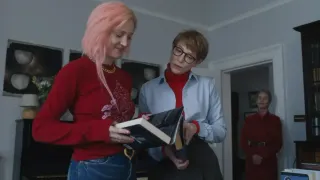
If you prefer your gay films on the light and earnest side, the Irish coming of age dramedy "Handsome Devil" is a satisfying selection. In it, Ned, a bookish lad with dyed red hair, is forced by his parents into a testosterone-heavy boarding school where the student body is united by their passion for rugby above all else. Ned is instantly labelled a homo and the easy object of teasing. His daily dread intensifies with the arrival of a handsome jock who encroaches on the room he was initially allowed to have to himself. The wall he built to divide the room, however, quickly crumbles as a love for music brings the two boys together. Predictably, new arrival Conor is torn between his sincere roommate/buddy and the popular rugby boys to whom he wants to prove his worthiness (including his heterosexuality). This is the kind of flick in which the antagonistic characters -- the rugby rascals and the hellbent-on-victory coach are humorous in their arrogance and vigor. And the witty English teacher is the one who provides the wisdom -- not to speak in a "borrowed voice." The story may borrow a lot from the slew of coming of age and gay coming of age films preceding it, but the characters of Ned and Mr. Sherry carry the film with their cleverness and forbearance in the face of boarding school idiocy. ("Handsome Devil" screens in the Festival on March 18 and 22.)
Several films in the fest examine the lives of notable artists. "Egon Schiele: Death and the Maiden," is one of these. Like Ozon's "Frantz," it takes viewers to the German-speaking world during World War I; but the mood in this Austrian feature is much less somber. This biographical depiction of the titular painter/illustrator is steeped in the passion of a posh young man whose sexuality persistently stirs trouble for him. Egon is as aloof regarding bourgeois moral standards as he is driven in his artistic creation, sketching nude after nude of very young women or girls. One model happens to be his younger sister, Gertie; and there are intimations of the inappropriateness of their relations. Intimations become damning accusations as his practice comes into question in regards to a much younger girl. The film opens with a bed-ridden Egon and, the hrough flashback, chronicles his bohemian strivings to escape the safety of his native milieu, his attempts to evade the trappings of marriage and expectations of monogamy, and his anxiety around his artistic output being ruined by conscription. ("Egon Schiele: Death and the Maiden" screens in the Festival on March 25 and 27.)
"Cezanne and Me" is not dissimilar in its depiction of the torments of the artistic life. This French feature focuses on the strained relationship between painter Paul Cezanne and writer Emile Zola. The former fancies himself an ultimate reject, refused even by those who are refused by the Academy -- the oppressive regulator of artistic tastes of the day for Parisian society. As boys, it was Cezanne who came to Zola's aid when he was an Italian lad being assaulted by bellicose grade school boys, but as adults Zola is prolifically published, esteemed in certain realms, and cozy in his new bourgeois comforts, such as a lovely country home full of art and vintage furniture. In middle age, Cezanne continues to fume and rage, his angst amplified by Zola's unkind depiction of him (of painters in general, but he takes everything as a personal attack) in his successful novel, "The Masterpiece." He curses the establishment, and on the one hand there is something admirable about his undying renegade spirit and his defiance of the monogamy mandate. But he is sad and unaccomplished, artistic genius though he may be. He is the sort of tormented soul who annihilates friendships. But the film is not torment upon torment; its narrative is a finely balanced biography of two acclaimed men who wield their prodigious talents very differently and with very different results. ("Cezanne and Me" screens in the Festival on March 3 and 7.)
The Chicago European Union Film Festival (CEUFF Festival) runs March 3 - 30 at the Gene Siskel Film Center of the School of the Art Institute of Chicago,164 N. State Street, Chicago, IL. For further information, visit the Siskel Film Center website.