April 30, 2019
The White Crow
Lewis Whittington READ TIME: 3 MIN.
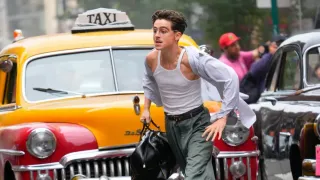
Ralph Fiennes' new film "The White Crow" dramatizes the early career of ballet superstar Rudolf Nureyev. Visually stylish, the film covers Nureyev decision to defect to the West while he was on tour with the Kirov Ballet in Paris in 1961. In flashbacks, we see scenes from his life of peasant poverty in Ufa and his pivotal training as a rebellious 17-year-old ballet student of Russian ballet master Alexander Pushkin.
Fiennes said that he has wanted to tell the story of Rudi's escape from Soviet Russia after he read Julie Kavanagh's biography of Nureyev, the most comprehensive biography to date. The screenplay, by David Hare, is a marvel of dialogue economy in Russian, French, and English, but is spare on some essential facts.
The title comes from a Russian folk term meaning rare bird. Nureyev was actually dubbed Iron Butterfly, and you wonder if the film looks to dial back Nureyev's gay identity.
For all intents, though, Ukrainian ballet dancer Oleg Ivenko has the magnetic charm and a potent naturalism in his portrayal of the young Nureyev. Ivenko's has an elusive, feral mystique that is key to understanding Nureyev both on and off the stage.
Nureyev was not only an international celebrity almost instantly after his escape to the West, but he was also perhaps the most famous gay man in the world. That is downplayed in this film, in an intimate scene with Rudi in bed with Teja, one of his boyfriends of this time. German actor Louis Hofmann steals this scene, reading Rudi's true nature.
Instead, the film focuses on his romantic friendship with Claire Saint, a well-connected Parisian, who Nureyev befriends and uses, seemingly, as a beard to distract the steely eye of the KGB. Ad�le Exarchopoulos gives a strong performance and navigates some disjointed exposition, but she puts her feelings aside and triumphs as the beautifully heroic friend he needs most.
Disappointing quick-cut footage of Ivenko dancing in legendary Nureyev roles that include "Don Quixote" and "Le Corsaire" showcase the electrifying talent that marked his early career. Fiennes also opts to show more of Nureyev's training in the studio with legendary Russian ballet master Alexander Pushkin.
Fiennes plays a humorously austere Pushkin. His demeanor and physicality are almost invisible, except for a rare glint in his eye that speaks volumes. Chulpan Khamatova plays Putin's wife, Xenia, who takes charge of Rudi after he breaks his ankle in a dance fall. She nurses him back to health as a cover for seducing him.
The film features premier danseur Sergei Polunin, who portrays Nureyev's straight roommate on the Kirov tour. Sergei publicly supports Vladimir Putin's policies that criminalize homosexuality in Russia, and he even has a tattoo of Vlad on his chest. Polunin was set to play Prince Sigfried in The Paris Opera Ballet's "Swan Lake," but the company dismissed him earlier this year over his homophobic and sexist rants on social media.
Meanwhile, the production design in "The White Crow" is exquisite. Mike Eley's cinematography keeps giving, especially with the gorgeous Russian and Paris exteriors. The set and costume period designs flawless, and Fiennes' eye for screen composition impresses; the black and white sequences of Nureyev poverty-stricken family of his childhood of the early '40s are stirring and visually stunning.
"The White Crow" is a mixed dance-film bag. But at least it is not another dance film about creeper directors, obsessive choreographers, ballerinas with eating disorders or dancers cutting themselves (or others). The story of Nureyev defecting to the west is a compelling story, but the movie plays it safe - something Nureyev never considered doing.