Aug 25
Luis Felipe Chávez – Painter blends his personal journey into new works
Jim Provenzano READ TIME: 1 MIN.
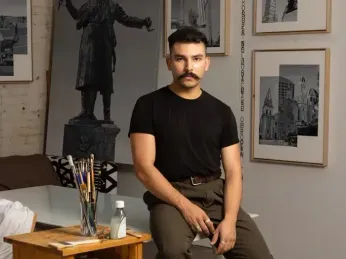
While he’s only been in San Francisco for almost five years, painter Luis Felipe Chávez has already exhibited at several local galleries with his impressive array of work, ranging from the personal to architectural symbolism.
His next exhibit, “INTERmedio,” opens at Jonathan Carver Moore Studios on August 28, and focuses on large works over the past few years that blend architectural sites and buildings in San Francisco and Mexico City that intersect like photographs. For Chávez, it symbolically blends his personal journey of immigration from Mexico.
In the interview with the Bay Area Reporter, Chávez, 29, discussed his other work that includes self-portraits, religious iconography, and even themes of queer sexuality.
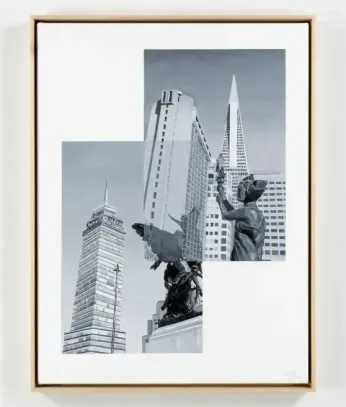
“This is about my immigration path, my story of integrating from here to the States from Mexico,” said Chávez. “All these paintings that I’m presenting are about these physical places that we are existing, like the streets in the city, monuments, or buildings, and what conversation we have with those places or with those buildings.”
While he originally worked in his apartment, he’s recently moved into a studio at the Pacific Felt Factory, enabling him to develop larger paintings. Chávez created some of his paintings in the series in 2020 at the height of the Coronavirus pandemic lockdown.
“I thought, ‘What’s going to happen?’ I was pushing myself to do something more photographic. It’s the first time that I’m doing something like that. It was more like a challenge to find this balance between doing a painting that looks like a photograph but not really that realistic.”
Being t/here
The irony is not lost on the artist that most of California was originally part of Mexico.
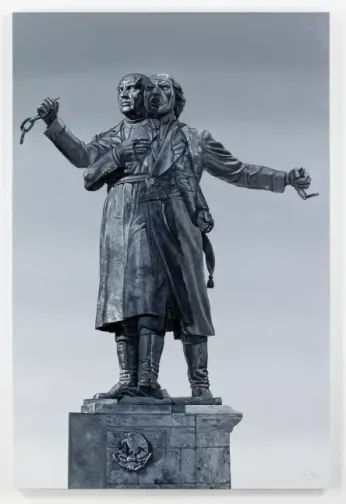
“Yes, yes,” Chávez agreed. “One of the biggest paintings that I’m presenting is of a statue of Miguel Hidalgo [called ‘the father of Mexican independence’], and it’s this overlap of the one that’s in Dolores Park, and the other statue is of the same guy in Guadalajara, the city where I grew up. So, I’m doing this overlap of the same person, but I’m not focusing really about this persona or this guy who helped to liberate Mexico. My point of view here is more, what is the concept or what is this image that we have about freedom, or what is freedom for us?
“The one that we have here in Dolores Park is more really looking pretty, really calm, and just presenting himself, and the one that we find in Mexico is really aggressive, and he’s breaking a chain.”
While the “INTERmedio” exhibit may be more austere, some of Chávez’ other works are more visibly personal, even erotic or gothic in tone.
“Seven of the paintings that I’m presenting are in black and white, and usually I paint in color. My desire was speaking about my immigration journey, but I don’t want to be that literal. I want to talk about the places where I exist in Mexico and which places I am existing right now, and that conversation that I’m having with those places and what relationship have my past with this present that I’m living.
“In that way, it’s telling my story, but it’s not my particular story. It’s just I’m talking more about the places. These places are public places, so everybody’s existing there or the people here in the city or the people who is living now in Guadalajara.”
Chávez has also exhibited at Queer Arts Featured, Ruth’s Table, both in San Francisco, as well as in Palm Springs galleries.
“My intention is open more my panorama and show my work in more places,” he said, adding that working with Moore was “easy and really professional. I feel so lucky that now we can have these places for POC artists and for queer people.”
Sense of self
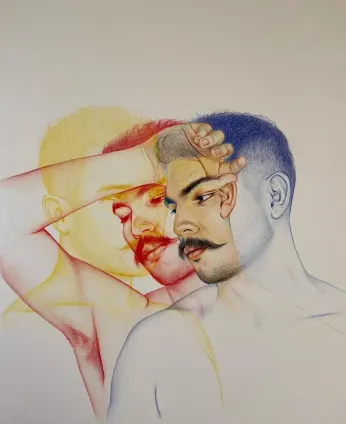
Some of Chávez’ earlier works include pencil figure studies with a double-image twist, and a few that lean toward the gruesome.
“I grew up Catholic, and I think that part of my work is related to Catholicism,” said Chávez. “I grew up with all these images of Jesus covered in blood and all the stories in the religion, so I think it comes from that. I’ve also existed with depression and anxiety. The world that we are living in now is too much sometimes. There’s a lot of pain and a lot of suffering. I guess I want to have a conversation with that and feel myself representing that in my painting.”
His self-portraits offer insight as well.
“With some of those, like ‘Rupture,’” he said, “I used a photo from when I started college at 18, and then in the middle when I was 22, and then at the end when I was 24 or 25. It was more like all this process and anxiety of being in college, trying to be an artist and being in the academy and all that. I created that painting when I finished college. In some way, I thought, ‘I kind of want to kill my past,’ but not really. I just wanted to start again, with my own knowledge, trying to build myself as really integrated with all of the things that they taught me.”
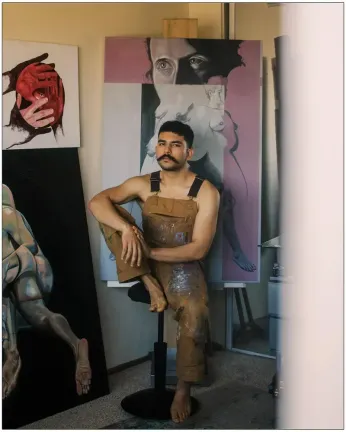
“My depression was so bad during that time that I had thought of suicide,” he said. “I had two friends who passed away in that way. My creative practice and my painting helped me to find a catharsis of those feelings. I was trying to do the symbolic act, to kill all these ideas and get over that and just continue with my daily life. When I’m creating, when I’m working in the studio, I’m building, creating this kind of mirror when I can see myself, and then I can build myself during the time that I’m working.”
Asked if he feels more comfortable now –or even perhaps obligated– to visualize an aspect of being gay into his art, Chávez said, “I feel an obligation to express myself, and with that, saying that involves everything or all the parts of the persona that I am. It’s my queerness there, also the Mexican aspect of my vision.”
“I’m trying to not hide anything. I grew up in a small town and in church, so the way that I grew up was like hiding myself. So now, yeah. Part of my artistic practice, is just, ‘No. Just express yourself there and put yourself there with your queerness, with your softness, with everything that you have.’”
Luis Felipe Chávez’ ‘INTERmedio,’ August 28-September 27 at Jonathan Carver Moore Studios, 966 Market St. Opening reception Sept. 4, 6:30pm-7:30pm. Thu & Fri 12pm-6pm; Sat. 12pm-4pm or by appointment.
https://www.jonathancarvermoore.com/
https://luisfelipestudio.com/
