Oct 14
Multiple cities, counties join San Francisco City Attorney Chiu in filing amicus brief in federal LGBTQ funding lawsuit
Matthew S. Bajko READ TIME: 5 MIN.
A dozen cities and counties from across the United States have filed an amicus brief urging the 9th U.C. Circuit Court of Appeals uphold a lower court decision in favor of seeing nine LGBTQ and HIV organizations not lose their federal funding. At stake is millions in dollars for services targeted to queer and transgender Americans, as well as the fiscal standing of the nonprofits providing such programs.
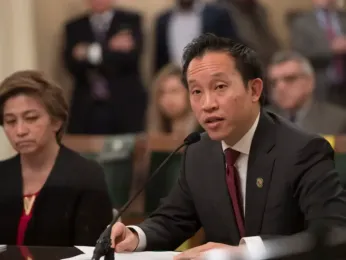
The office of San Francisco City Attorney David Chiu exclusively shared with the Bay Area Reporter the 23-page brief it filed on behalf of the coalition of municipalities in the federal lawsuit San Francisco AIDS Foundation v. Trump. The local HIV service provider is among the lead plaintiffs in the case, along with the San Francisco Community Health Center and the GLBT Historical Society.
Represented by the Lambda Legal Defense and Education Fund, the LGBTQ-focused nonprofits sued the Trump administration earlier this year after it moved to defund them amid its crackdown on LGBTQ services and diversity programs. Also joining the case were the Los Angeles LGBT Center; Baltimore Safe Haven; FORGE Wisconsin; the Bradbury-Sullivan Community Center in Allentown, Pennsylvania; the New York City LGBT Community Center; and Prisma Community Care in Phoenix.
In June, U.S. District Judge Jon S. Tigar granted a preliminary injunction temporarily blocking the Trump administration from rescinding the federal funds awarded to the nonet of service providers. As the B.A.R. reported in July, it led to more than $6 million in grant funding being returned to the nine LGBTQ and HIV organizations.
Nonetheless, the case continues to move forward through the federal judiciary and is likely to be taken up by the U.S. Supreme Court. If it does, there is concern the conservative supermajority on the court could side with Trump and allow his anti-trans and anti-DEI executive orders to take effect.
Should that happen, it would “cripple” the partnership cities and counties have created with local nonprofits to protect the public’s health, warns the amicus brief from the local officials. They also contend the municipalities will be further harmed should their residents not receive the medical care and social support they need if the Trump administration prevails.
“Local governments, including amici, will be harmed if appellees and other nonprofits lose federal funding. Localities will lose trusted partners that work with communities impacted by high concentrations of infectious diseases, including hard-to-reach communities,” notes the amicus brief. “Some patients previously served by these non-profits may seek services through local health departments, which will further burden local jurisdictions at a time when they are already facing significant budget deficits.”
Chiu, a former city supervisor and state lawmaker, has seen firsthand the important interplay between government entities and nonprofit service providers in providing health care to disadvantaged communities, whether it be the LGBTQ or minority communities.
“In San Francisco, we recognize, support, and celebrate our transgender communities,” stated Chiu. “These executive orders would devastate the delivery of essential health services, from HIV prevention to gender-affirming care. Local governments rely on trusted nonprofit partners to deliver these services. Our coalition is standing together to ensure residents continue to receive essential services from organizations who have deep roots in the communities they serve.”
Joining San Francisco in the amicus brief are Alameda and Santa Clara counties in Northern California, Allegheny County in Pennsylvania, and King County in Washington state. Along with San Diego, the other cities that signed on to it are Baltimore, Chicago, New York City, Alexandria, Virginia; Columbus, Ohio; and Portland, Oregon.
“Should nonprofit partners, including appellees, lose federal funding, amici jurisdictions would be unable to replace the critical healthcare services the nonprofits currently provide,” the dozen municipalities warn in their brief. “Given significant budget deficits faced by many local jurisdictions, amici are not in a position to cover the lost funding or services.”
Even though none of the named plaintiffs in the lawsuit are located in Santa Clara County, gay Deputy County Executive David Campos told the B.A.R. his jurisdiction has a large LGBTQ population and the county works with multiple local nonprofits to provide services to it. During Trump’s first administration the county sued it more than any other local jurisdiction, noted Campos.
Thus, signing on to the amicus brief is “consistent with that tradition,” he said.
“The county is unafraid to speak out whenever there is an injustice,” said Campos. “The reality is we have a strong history of supporting the LGBTQ community. We have a strong LGBTQ presence here, so it is concurrent with that history and the views of our board of supervisors that we would join this effort.”
Santa Clara County also needs “to stick together” with its counterparts in other cities and counties in ensuring they “use every tool we can to protect our residents,” added Campos, a former San Francisco supervisor.
“I think it is really critical to stand up to what is happening in D.C. and the attacks on all of these communities, not just immigrant communities and communities of color, but the LGBTQ community,” said Campos, a vice chair of the California Democratic Party. “Of course, for folks who are living with HIV, this is a matter of life and death, so it is really critical that we push back.”
Last Friday, October 10, California Attorney General Rob Bonta co-led with his counterparts in Illinois and Massachusetts a group of 17 attorneys general in submitting their own amicus brief n support of the LGBTQ service providers. The other attorneys general who joined the brief are from Colorado, Connecticut, Delaware, Hawaii, Maine, Maryland, Michigan, Minnesota, Nevada, New Jersey, New York, Oregon, Rhode Island, Vermont, and Washington.
Among the arguments they made are that Trump’s executive orders lacked clarity around the proposed certification requirements, created confusion and compliance burdens harmful not only to states but also individuals and businesses. They also criticized there not being clear definitions of key terms like “diversity,” “equity,” “inclusion,” or “accessibility” in the orders or explanations for what aspects of such terms violate federal law.
They also noted that states and private agencies can’t “anticipate what funding streams might be cancelled or why” due to the executive orders.
“Trump’s continued attacks on programs that promote diversity, equity, inclusion and accessibility threatens to rip crucial support structures from under the feet of transgender individuals and other vulnerable populations,” stated Bonta, who has filed numerous lawsuits of his own this year against the administration. “My fellow attorneys general and I will continue to oppose these attempts to undermine data-backed programs that provide social and economic benefits and help people of all backgrounds and identities grow and prosper.”
At the heart of the legal dispute are a trio of executive orders Trump signed after starting his second term in January. No. 14168 states that, “It is the policy of the United States to recognize two sexes, male and female,” and defines sex as “an individual's immutable biological classification” and not a synonym for gender identity.
The order on gender identity also prohibits federal contractors and grantees from recognizing and respecting their identities or advocating for their civil rights. The other two executive orders are Nos. 14151 and 14173, which terminate equity-related grants and prohibit federal contractors and grantees from employing diversity, equity, inclusion, and accessibility principles in their work.
"These executive orders not only completely ignore the history and lived experiences of transgender people, they fly in the face of scientific research, expertise, and fundamentally interfere with our ability to serve our most vulnerable community members,” stated Honey Mahogany, a Black queer trans person who is director of San Francisco’s Office of Transgender Initiatives. “San Francisco has long been at the forefront of the fight for human rights and continues to be known across the globe as a refuge for the LGBTQ community. I am proud that we are continuing in this tradition and standing up for our values at this critical time.”