Oct 28
LGBTQ History Month: SF filmmaker plans doc on late gay activist Kohler
Matthew S. Bajko READ TIME: 7 MIN.
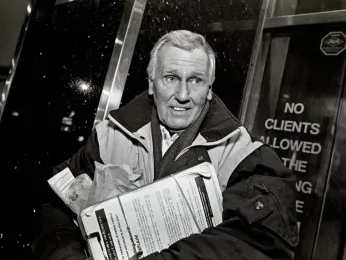
Among those at the forefront of New York City’s gay rights movement in the 1970s and 1980s was the late activist Bob Kohler. The native New Yorker and Navy veteran helped form the Gay Liberation Front and managed the Club Baths during the early days of the AIDS epidemic.
When city officials shuttered such businesses in an attempt to stop transmission of the disease, Kohler opened clothing store The Loft with locations on Christopher Street in Manhattan’s gay West Village and in the gay resort town of Fire Island. He was a member of ACT UP and worked with such groups as Sex Panic! and Fed Up Queers in the 1990s.
“We all owe Bob our gratitude for a life devoted to our liberation and an obligation to keep his memory alive,” Matt Foreman, a gay man who at the time led the National Gay and Lesbian Task Force, told the Bay Area Reporter after Kohler died December 5, 2007, at the age of 81.
Yet, nearly two decades later, Kohler is hardly a household name when it comes to LGBTQ history. He is mentioned in a National Park Service writeup about Christopher Park, part of the Stonewall National Monument, and how Kohler had befriended the “street youths” who frequented it due to his living on nearby Charles Street and walking his pet schnauzer Magoo to the tiny green oasis.
“The street kids had bag-woman drag," Kohler is quoted as telling author David Carter for his 2004 book “Stonewall: The Riots That Sparked the Gay Revolution.” "They wore sandals and tied their blouses or shirts in a big knot midriff, and that was basically it. It was just ragged, hausfrau drag, whatever they could get together.”
Very little has been written about the role Kohler played in the early days of the modern LGBTQ rights movement since his obituaries ran 18 years ago. His family and friends fear Kohler could fade into obscurity as his contemporaries and loved ones pass away.
“I am Bob’s nephew and I don’t want Bob Kohler’s name to be anything else than inspirational. I need to do my part,” said Gary Kohler, 71, who lives with his wife in Pleasanton, California.
Unlike the names of others from the Stonewall generation who have become well known LGBTQ figures in recent years, Gary Kohler told the B.A.R. during a recent phone interview that his uncle “Bob’s name is not really mentioned as much as matched his actual output and efforts and results.”
Gay San Francisco-based filmmaker Dan Goldes aims to change that via a documentary he currently has in development about the late Kohler via his Urbanstreet Films. It has the working title of “Bob’s Queers: The Life and Activism of Bob Kohler.”
“One thing that makes Bob’s story special to me is the intergenerational reality of it. He was an older gay man very interested in ensuring young queer people coming up really had kind of a sense of history and also a sense of enthusiasm,” Goldes told the B.A.R. “I think he matched really well with the 19- and 20-year-olds in ACT UP. He was a 60-year-old man by then.”
While Goldes’ film will not premiere in time for what would have been the centennial of Kohler’s birth on May 17, 2026, he is hopeful of seeing it debut at an LGBTQ film festival, such as San Francisco’s Frameline held each June, in 2028. He is actively fundraising from individual donors to support the making of the expected 80-minute feature and will begin seeking institutional backers in December.
“We are talking at least two or three years down the road, at least,” said Goldes when asked how long he expected it would take to make the film.
Archive search planned
A big part of his focus will be on searching various archives across the country to see what they have about Bob Kohler in their holdings. One “invaluable” source he came across is a three-hour recorded interview the poet and rock singer Penny Arcade did with Bob Kohler for her Lower East Side Biography Project. She had posted about it on Instagram just before Christmas last year.
“He tells his life story. It is kind of invaluable to me,” said Goldes, who has also been speaking with and filming Bob Kohler’s nieces and nephews as part of his research and early prep work for the documentary.
Gary Kohler, president of the Tri-Valley branch of the Sons In Retirement, an organization for men when they retire, spent his teenage years in Pasadena, California and later, after moving to the Bay Area, worked as the director of sales and marketing at a San Francisco hotel on Market Street where he routinely worked with LGBTQ leaders hosting events at it. While his four older siblings got to know their uncle fairly well, Gary Kohler didn’t get to see him much, as Bob Kohler preferred to remain in New York.
He did know his uncle had a male partner even though, as a “little kid,” Kohler’s family didn’t explain to him what that actually meant, recalled Gary Kohler, who as an adult was able to visit his uncle several times in Manhattan.
“When I had business trips to New York, I had a couple meals with my uncle,” he said.
His late father, Raymond Kohler, was a “fairly conservative” Republican but also employed as his assistant at the airline where he worked a gay man with a partner, whom the Kohlers befriended and would visit for dinners. Due to his job, Raymond Kohler would offer his brother Bob first-class tickets to visit his family in Southern California.
Yet, recalled Gary Kohler, his uncle rarely accepted them.
“He was always too busy. My dad was always so frustrated with how busy he was,” recalled Gary Kohler, a registered Republican for much of his life until the party first nominated Donald Trump as its presidential candidate, prompting him to re-register as a Democrat.
It was his political posts on Facebook during that time that had caught the attention of Goldes, who knew Gary Kohler from his time working for the city’s tourism bureau in the 1990s and 2000s. They struck up a friendship via the social media site, and Goldes pitched Gary Kohler about filming him for a short feature about his political evolution.
Last summer, Goldes spent an afternoon at Gary Kohler’s East Bay home and interviewed him on camera. During the course of their conversation, Kohler mentioned the political irony of his conservative dad having a brother who was a “big gay rights activist” in New York City.
“I thought, ‘Huh. Not only was it interesting that this family produced such two polar opposite people, but also how come I never heard about Bob Kohler,’” recalled Goldes, whose short film about Gary Kohler can be seen here .
With a trip to New York planned last October, Goldes decided to do some research into Bob Kohler’s life and got in contact with some of his contemporaries from back in the day. He met with several of them on another trip last December, filming them with the thought he would produce a short film about Bob Kohler.
“The more I got into it, the more I realized it was a much bigger story,” explained Goldes about his pivot to wanting to make a full-length documentary. “It also became clear what was happening in Washington, D.C. and the rest of the country via the Trump regime was akin, in many ways, to the circumstances when Bob was protesting and really repeating his activism. There was a story there about somebody who showed up every day to try to make life better for people in the face of really daunting odds.”
And he did so as an attractive white man with money and privilege who could have not bothered to show up for the various causes and people of lesser means that he fought for and alongside throughout his life, noted Goldes.
“He used every one of those privileges to bring attention to gay rights, the fight for civil rights, the fight for women’s rights, the fight for anti-police brutality, the anti-war fight. I just thought about the fact that he just showed up every day, and coming out of that background really struck me. I found it quite inspiring, particularly in the times we are in right now,” said Goldes.
He is working, for the first time, with gay film producer Mark Smolowitz, who came on board as a consulting producer for the film about Bob Kohler. Goldes estimates he needs to raise at least $500,000 to complete the documentary about a gay forefather who was okay with being another face in the crowd during his lifetime yet left a lasting legacy nonetheless.
“I think he showed up – literally,” said Goldes about Bob Kohler’s prolific presence at demonstrations and protests throughout his life. “He didn’t have to be the guy in the front and the lead organizer, but he showed up at a demonstration to support the people who were arrested. He would be in court with people who had been arrested.”
Since his uncle’s death, Gary Kohler said he has come to realize just how much of a leader his uncle was and the impact he had.
“As I got older, I learned here is somebody who we hardly talked about when I was a kid who is a major source of pride. He is someone our family should be super proud about,” he said.
Tax-deductible donations to assist Goldes in making his documentary can be made via the Center for Independent Documentary. Information on how to do so online or by check can be found here.