Nov 12
Editorial: Big win for LGBTQ seniors
BAR Editorial Board READ TIME: 3 MIN.
Late last week, the California Supreme Court issued its long-awaited decision in a case that impacts LGBTQ seniors. The anti-LGBTQ Taking Offense organization filed a lawsuit several years ago against gay state Senator Scott Wiener’s 2017 bill creating an LGBTQ Seniors Bill of Rights. Then-governor Jerry Brown signed it into law. Among its provisions is a requirement that employees at senior care facilities address residents by their preferred pronouns. A state appeal court in 2021 ruled that provision violated First Amendment protections for free speech. Attorney General Rob Bonta’s office disagreed and appealed that decision to the state’s high court.
In its November 6 decision, which was unanimous via the main opinion and two concurring ones, the Supreme Court upheld anti-discrimination protections of LGBTQ residents of long-term care facilities in the Golden State. The court’s opinion holds that the law’s requirement that facility staff refer to LGBTQ residents by their proper name and gender does not violate anyone’s right to free speech.
Bonta was pleased with the ruling. “All individuals deserve to live free from harmful, disrespectful rhetoric that attacks their sense of self, especially when receiving care necessary for their continued well-being,” stated Bonta. “State law prohibits harassment in the workplace. I am glad that the California Supreme Court agrees with us on the importance of these protections and has affirmed their constitutionality.”
Specifically, Wiener’s law prohibits long-term care facilities from intentionally deadnaming someone, that is, calling a transgender person by the name they were assigned at birth, or willfully using the wrong pronoun in referring to them. It was this provision to which Taking Offense objected. However, Bonta noted in his release that the court found that the provision is appropriately narrow enough as to not violate the First Amendment, as it specifically protects long-term care residents against discrimination in a setting in which they are a “captive audience.” The law does not restrict care facility staff from expressing their views on gender when not providing care to residents.
“As previously described, the provision is limited to willful, repeated, and knowing acts done on the basis of a protected characteristic, and it applies only in the regulation of those whose job is to provide intimate personal and medical care to long-term care residents,” Chief Justice Patricia Guerrero’s majority opinion stated. “The provision does not prevent facility staff from expressing their views about gender in any otherwise lawful manner. Moreover, the statute reaches solely conduct that creates a hostile environment.
“Plaintiff’s facial challenge to Health and Safety Code section 1439.51, subdivision (a)(5) fails because the pronouns provision constitutes a regulation of discriminatory conduct that incidentally affects speech, is not subject to First Amendment scrutiny as an abridgment of the freedom of speech, and plaintiff has not carried its burden to ‘demonstrate ... invalidity in at least ‘the generality’ or ‘vast majority’ of cases under the ‘exacting’ standard of a facial challenge,’” Guerrero’s decision stated.
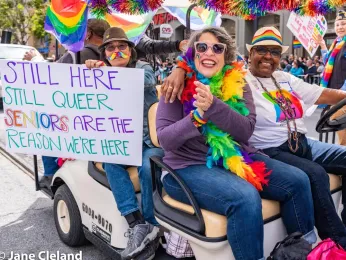
This is a narrow ruling but it protects the rights of LGBTQ seniors. And, in this age of constant politicization of everything, especially things pertaining to the trans community, like proper names and pronouns, it’s crucial that older LGBTQ people have protections.
SAGE, a national advocacy and services agency for LGBTQ seniors based in New York City, noted that a 2021 study from Rush University Medical Center found bias is a real issue in long-term care and other facilities. “Lesbian, gay, bisexual, transgender, and queer residents in assisted living and other long-term care settings fear discrimination, necessitating a ‘dramatic, systematic change’ to care to protect those residents and promote equitable health care,” the agency noted about the study’s findings.
And, as SAGE noted, the population of older LGBTQ people is only going to increase. “The number of LGBTQ+ individuals aged 65 or more years worldwide is expected to be between 1.6 billion and 2 billion by 2050, according to the study authors,” SAGE stated on its website. “LGBTQ+ older adults are more likely to live alone, be socially isolated and have less family support, disproportionately leading to a reliance on long-term care, according to the authors. Without protective policies and practices, this population can be at risk for issues such as access to care and living arrangements.”
That’s why things like staff training and laws like California’s are so important. It’s necessary that staff are trained in respecting all residents in care facilities, including LGBTQ elders.
We’re glad the state Supreme Court affirmed California’s protections regarding proper names and pronouns for LGBTQ seniors. It offers some peace of mind to those LGBTQ seniors residing in such care facilities.