Dec 2
Sondheim, side by side – ‘Sunday in the Park with George’ at Shotgun Players and ‘Into the Woods’ at SF Playhouse
Jim Gladstone READ TIME: 1 MIN.
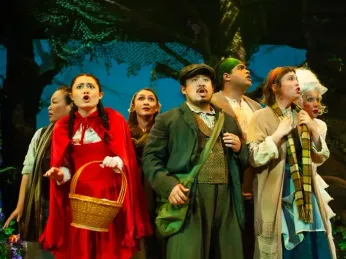
It’s hard to imagine a better gift for local theater lovers than the chance to see two first-rate productions of Stephen Sondheim musicals running on Bay Area stages simultaneously.
The opportunity to take a fresh look at, and listen to, “Sunday in the Park with George” and “Into the Woods” in tandem is more intellectually rewarding and emotionally nourishing than seeing either show on its own. It’s a delectable holiday treat.
These two musicals, originally mounted back-to-back on Broadway in 1984 and 1987, have come to be considered classics over time. But the original production of each received tepid, though respectful, reviews.
Even as appreciation of their warmth, intricacy and wit has grown over time and revivals, both have been reductively branded in public consciousness: “Sunday in the Park with George” as Sondheim’s most avant-garde work; “Into the Woods” as his most accessible and family friendly.
But local theatergoers who take advantage of the welcome opportunity to see both within a few days, or weeks, will appreciate the shows’ thematic overlaps and structural echoes.
Sondheim, an afficionado of puzzles, would surely endorse the teasing out of connections between these unexpectedly well-paired plays.
Rather than a full-fledged critique of either show (they’re both terrific), consider this a provocative field guide to the park and the woods. Be sure to schedule your outings promptly; tickets are going like December daylight.
All-too-true stories
“Into the Woods” deepens and interweaves well-known Brothers Grimm tales within an overarching original story (Sondheim is credited as composer and lyricist, the show’s book is by James Lapine).
One of its best-known songs is the lush, almost hymnal ‘No One Is Alone.’ At SF Playhouse, director Suzy Damilano stages this penultimate number as intertwined duets sung from far opposite sides of Heather Kenyon’s moody woodland set.
At stage left, Cinderella (Jillian A. Smith) reassures Little Red Riding Hood (Olivia Hellman), while off to the right, Jack, of beanstalk notoriety (William I. Schmidt), is comforted by one of Sondheim and Lapine’s original characters, the Baker, sung with radiant tenderness by Phil Wong, whose performance throughout is among the show’s highlights.
But the song is a momentary balm: The two clinging pairs remain separated from each other across a dark hollow. Over the course of their often self-serving journeys through a landscape of perpetual ambiguity, the show’s characters come to recognize that even the closest, most earnest relationships are at constant risk of accident and instability.
‘Happily ever after’ itself seems the fairy tale. Sunshine and shadow dance in perpetuity. Everyone is alone, together.
Art and intimacy
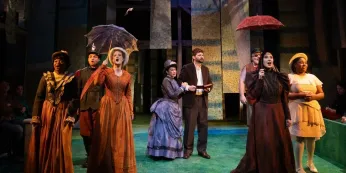
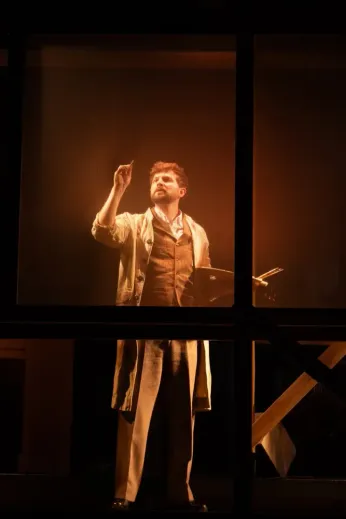
The bittersweet tension between solitude and communion also provides a dramatic engine in “Sunday in the Park with George.” Fictionally embroidering upon the real life of pointillist painter Georges Seurat, Sondheim, with book writer George Furth, ponders the balance between outsider artists’ sense of alienation and their willful seclusion.
Seurat (played at Shotgun by Kevin Singer) unable to see (or unwilling to look?) beyond his obsessive artistic vision, blinds himself to the emotional needs of his paramour Dot (Marah Sotelo, in a powerfully sung performance) and the stylistic conventions demanded by the art.
His perspective ultimately leads to both a mutually agonizing breakup and a history-making masterpiece (the painting “Sunday Afternoon on the Island of La Grand Jatte”).
The show’s second act jumps forward a hundred years and focuses on Seurat’s great-grandson, George (also played by Singer). He’s an electronic artist with a successful career that’s been bolstered by his skills at biting his tongue to schmooze with the gatekeeping critics, curators, and collectors that Great Gramps would have blown off.
In Act I, Sondheim illuminates Georges and Dot’s split with the wrenching “We Do Not Belong Together.” In Act II, George’s strategic compromises are satirized in the superficially celebratory “Putting It Together.” The ironies gnarl marvelously, like a tangle of trees in the woods.
Personalities on parade
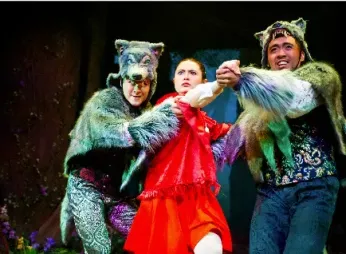
Both musicals are heavily populated with characters, elegantly and economically drawn by Sondheim. The distinctiveness of their personalities and sub-narratives within the shows’ broad frame stories is finely honed by directors Damilano at SF Playhouse and Susannah Martin at Shotgun Players along with their keenly cast ensembles.
While there’s not a dud in the bunch, standouts among the woodland crew include Ruby Day, who brings an impressive emotional range to her take on the Baker’s Wife, perfectly proportioning the ratio of comedy and pathos in every moment.
Alison Ewing throws down couplets with hip-hop flair as the Witch (Call her Margaret “Hamilton”); Trevor March tickles as Cinderella’s Prince, a one-man odd couple of basso voice and baby face; and Maureen McVerry makes the most of a minor role, the cow Milky White (Her pink-tasseled teats are among many clever touches in costume designer Kathleen Qiu’s enormous wardrobe).
Madeline Berger’s equally impressively dressing at Shotgun—note the subtle brushstroke markings on the Victorian outerwear—goes a long way toward creating visual coherence among the characters Act I’s tableau-in-motion.
In the Seine scenes, Alex Rodriguez toggles marvelously from Jules, a sharp, condescending gallerist, to Louis, a sweet, people-pleasing pâtissier.
Lucy Swinson brings delicious specificity to her first-act role as a strolling flirt and her post-intermission turn as a fatuous socialite.
And William Brosnahan lends his “bro” to an arrogant soldier and a smug ’80s artist, who both seem descended from the princes of “Into the Woods.”
The gift of a twist
Each of these shows’ first acts could almost stand on its own as a complete and satisfying production (In fact, a version of “Into the Woods” marketed to student and community theater groups omits its Act II), but both are enriched and complicated by post-intermission twists.
In their second acts, the narratives drop all semblance of straightforwardness. Audiences are challenged to shift perspectives and question assumptions. It’s exhilarating.
One suspects that Steven Sondheim would never give a kid simple wooden blocks as a Christmas gift. He’d prefer to give Rubik’s Cubes.
‘Sunday in the Park with George’ extended through Jan. 25. $15-$90. Ashby Stage, 1901 Ashby Ave., Berkeley. http://www.shotgunplayers.org
‘Into the Woods’ through Jan. 17. $52-$145. 450 Post St. http://www.sfplayhouse.org
(Also, for yet more Sondheim pleasures, a film version of the acclaimed Broadway revival of Steven Sondheim’s “Merrily We Roll Along,” starring Daniel Radcliffe, Jonathan Groff and Lindsay Mendez, will screen at local theaters starting December 5. https://www.sonyclassics.com/film/merrilywerollalong/ )