3 hours ago
Vandalism of Reno’s “Biggest Little Rainbow Bridge” Sparks Outrage and LGBTQ+ Solidarity
READ TIME: 6 MIN.
When members of Girl Scout Troop 508 arrived at Crissie Caughlin Park in Reno, Nevada, to put the finishing touches on their new memorial project—a brightly painted rainbow bridge dedicated to pets that have died—they found it splashed and streaked with white paint. According to local reporting, the vandalism was discovered on November 25, 2025, just days before a scheduled December 7 ribbon-cutting ceremony that was to formally open the bridge to the public.
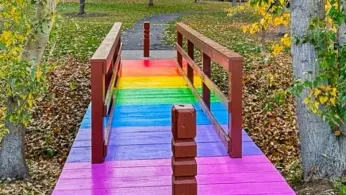
The bridge, known as the Biggest Little Rainbow Bridge, sits in Crissie Caughlin Park along the Truckee River and was envisioned as a peaceful place where residents could reflect on and grieve the loss of their animal companions. The Girl Scouts designed and built the wooden structure for their community project, painting the formerly reddish-brown bridge in multi-colored stripes to echo the popular “rainbow bridge” concept—a mythical, comforting place where pets are imagined to go after they die.
City officials in Reno, including the City Manager’s office and the Parks Department, quickly coordinated with Reno Police after the damage was reported, and a formal police report was filed. Reno Police confirmed they are “actively investigating” the vandalism of the Rainbow Bridge memorial project at Crissie Caughlin Park, gathering evidence to determine who is responsible.
Despite the shock and disappointment, city representatives described Troop 508’s response as “inspiring, ” noting that the Girl Scouts committed to begin repainting and repairing the structure the day after the vandalism was discovered. The City of Reno also announced that the ribbon-cutting ceremony for the bridge, planned for December 7, would proceed as scheduled, signaling an intention not to allow the attack to derail the project.
To support restoration efforts and broader park improvements, the City of Reno is working with the Community Foundation to establish a donation link so residents and supporters can contribute financially. The collaboration between municipal officials, the Community Foundation, and the Girl Scouts has been highlighted in local coverage as an example of community resilience in the face of targeted damage.
While local authorities have not publicly identified a suspect or confirmed a specific motive for the vandalism, images of the defaced bridge quickly circulated on social media and on Reddit, prompting speculation that the attack may have been motivated by hostility toward rainbow imagery often associated with LGBTQ+ pride. A local Instagram page shared a photo of the bridge after the white paint was poured across the colorful planks, accompanied by a caption criticizing whoever was responsible for defacing a community project built by young Girl Scouts.
PinkNews reported that commenters on Reddit and Instagram suggested the vandal or vandals “thought this was LGBTQ+ related and not for people grieving their dead pets, ” using strong language to condemn what they perceived as homophobic intent. However, law enforcement officials have not made a public statement confirming or denying whether they are investigating the case as a potential hate-motivated incident.
In quotes compiled by PinkNews, local residents and online commenters expressed heartbreak that a project created by children, aimed at helping people mourn their pets, had been targeted. One person, quoted via a local Instagram account, emphasized that the bridge was built by girls “no older than 12” and was meant as a compassionate space for farewells to animals, describing the vandalism as “heartbreaking. ” These reactions have helped frame the story not only as property damage, but also as an attack on youth-led community service and inclusive symbols in public spaces.
The Reno incident has drawn comparisons to other recent cases in which rainbow-colored items, including those linked to LGBTQ+ communities, have been vandalized or removed. PinkNews noted that in 2023, in Bristol, United Kingdom, children’s and young adult author Susie Day and her partner found their rainbow doormat vandalized with black spray paint that obscured the rainbow sections. Day told local outlet the Bristol Post that neighbors responded by buying their own rainbow doormats, filling the street with the symbol as an act of solidarity.
Incidents targeting rainbow crosswalks, murals, flags, and other public art have also been documented in various cities in recent years by LGBTQ+ media and advocacy organizations, which often interpret such acts as attempts to erase or intimidate visible expressions of LGBTQ+ pride. Although the Reno bridge was explicitly designed as a pet memorial rather than a pride installation, its rainbow design has led many observers, including LGBTQ+ community members and allies, to place the vandalism within this broader context of challenges to rainbow symbols in shared spaces.
For LGBTQ+ people and their allies, rainbow imagery often functions as a sign of welcome and safety, indicating that a community or institution affirms diverse sexual orientations and gender identities. When rainbow-colored structures are defaced—whether or not the targets were intended as LGBTQ+ symbols—it can heighten anxiety about public acceptance and safety, particularly for transgender people, nonbinary people, and other historically marginalized groups who already face discrimination in many environments.
Local news coverage of the Biggest Little Rainbow Bridge has focused primarily on the Girl Scouts’ initiative, the city’s support, and the police response. Reports describe Troop 508’s project as a memorial where families can “mourn the loss of beloved four-legged family members” and reflect on their memories, emphasizing the bridge’s role as a healing and inclusive space.
By choosing a rainbow design, the Girl Scouts tapped into a widely recognized visual language of hope and remembrance, one that resonates both with people grieving pets and with LGBTQ+ community members accustomed to seeing rainbows as a promise of visibility and belonging. The fact that much of the outrage has come from people highlighting the possible misreading of the bridge as an LGBTQ+ structure has, in turn, opened a conversation about how rainbow symbols are policed in public life and who feels entitled to challenge or erase them.
In Reno’s case, city leaders have not publicly framed the incident in explicitly LGBTQ+ terms, but their commitment to restoring the bridge and moving forward with the ribbon-cutting indicates institutional backing for a colorful, inclusive aesthetic in the park. For some LGBTQ+ residents and allies, that stance can be read as an indirect affirmation that public spaces should be safe for a wide range of identities, expressions, and forms of remembrance.
The vandalism of the Biggest Little Rainbow Bridge has also intersected with ongoing discussions about how youth-led projects that include rainbow imagery may be perceived in the current political and cultural climate. In recent years, some schools and youth organizations in the United States have faced pushback over LGBTQ+ inclusion efforts, such as pride-themed displays or gender-inclusive policies, with rainbow colors sometimes at the center of these disputes.
In this context, the Reno Girl Scouts’ decision to repaint and continue with their project despite the vandalism sends a message of persistence that resonates beyond pet memorials, suggesting support for young people who choose symbols associated with hope, diversity, and compassion. For LGBTQ+ youth and their peers, seeing adults and local governments stand behind colorful community projects may help affirm that they are valued and that attempts to erase inclusive symbols will be met with restoration rather than retreat.
The participation of the Community Foundation in fundraising efforts also underscores the role that civic and philanthropic organizations can play in reinforcing inclusive public art and memorials. When vandalism occurs, these organizations can help ensure that projects aligned with community values—including remembrance of pets, celebration of diversity, and public expressions of care—are not permanently silenced by acts of destruction.
As Reno Police continue their investigation, no arrests or suspect descriptions have been publicly reported in connection with the vandalism of the Biggest Little Rainbow Bridge. Local outlets have not announced any formal classification of the incident as a hate crime or bias-motivated offense, leaving official questions about motive unresolved. In the absence of confirmed information about who is responsible, advocates for LGBTQ+ people and for inclusive public spaces have urged caution about making definitive claims while still recognizing the emotional impact that attacks on rainbow imagery can have on marginalized communities.
In the weeks ahead, the restored Biggest Little Rainbow Bridge is expected to welcome visitors seeking a place to remember their pets, as well as those drawn by its layered symbolism. Whether approached as a site of personal grief, a testament to youth leadership, or a quiet affirmation of colorful, inclusive spaces in public life, the bridge’s survival after vandalism stands as a tangible reminder that communities can respond to acts of damage with visibility, care, and renewed commitment to shared values.