Dec 17
Sutter Health continues care for trans youth patients
Eliot Faine READ TIME: 3 MIN.
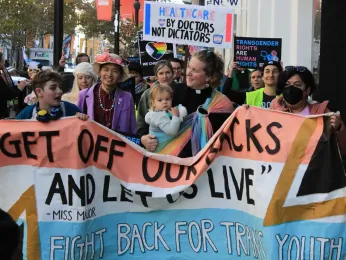
According to current patients and parents, Sutter Health has reversed course and will continue offering gender-affirming care for patients under 19. The health care company’s decision followed a protest by parents and activists outside its Emeryville offices December 8.
Two days later, on Sutter’s self-imposed deadline to end gender-affirming care by December 10, it reversed its decision.
Calder Storm, with Rainbow Families Action and a gay trans man and father, told the Bay Area Reporter that parents and patients who previously had their appointments canceled were rebooked.
Storm also said that Sutter Health hadn’t differentiated between continuing care for existing patients and taking on new patients.
“It was a moment of victory for the Sutter families, the other members of RFA, and activists and allies who came out for that protest, because we actually felt like we moved the needle,” Storm said. “Often in activism, it can be hard to celebrate small victories.”
The B.A.R. reached out to Sutter for a response. It did not have anything to add to its previous statement.
"Like other health systems locally and across the country, we are working to ensure compliance with recent federal actions and other developments affecting the provision of gender-affirming care only for patients under 19. We remain committed to approaching this with compassion, physician guidance, and compliance with applicable requirements,” a spokesperson for Sutter Health wrote December 8.
Another RFA advocate praised the decision.
“Our scrappy little group of parents have done what the attorney general of California and larger [institutions] and states have yet to do, which is to confront a health care system that’s trying to get rid of gender-affirming health care for minors, and made them stop,” Arne Johnson, RFA lead advocate and a cisgender father of a trans child and a nonbinary child, told the B.A.R.
In August, Attorney General Rob Bonta joined 14 state attorneys general and Washington, D.C. to file a federal lawsuit against the Trump administration as it interprets federal law to prevent gender-affirming care procedures at health providers that are recipients of Medicare or Medicaid coverage. The lawsuit refers to the executive order as the “denial of care” order. https://www.ebar.com/story/156463
The road so far
The decision by many hospitals across the country to pause gender-affirming care for youth came after an executive order from President Donald Trump in late January that declared the federal government “would not support the chemical and surgical alterations” of youth, such as hormone treatments and surgery, under the age of 19. An executive order is not legislation and does not require approval from Congress.
Despite this, other Bay Area medical facilities, like Stanford Health Care and Kaiser Permanente, moved to preemptively end gender-affirming care for minors over the summer as the B.A.R. previously reported.
In their initial letter to Sutter Health, RFA referenced how state law prohibits health care providers and insurers from denying care on the basis of gender identity. Senate Bill 107 was authored by gay state Senator Scott Wiener (D-San Francisco) three years ago. This year, Wiener successfully authored legislation to strengthen the law. Governor Gavin Newsom signed the bill in October.
Next steps
RFA is preparing for a decision from the federal Centers for Medicare and Medicaid Services, expected on Thursday, that would propose a rule to pull Medicare and Medicaid funding from hospitals that provide pediatric gender-affirming care. Proposed rules must go through a federal regulatory process before they can take effect.
Part of that process is a 60-day open comment period, where constituents will be able to voice their feedback about the proposed rule.
Johnson told the B.A.R. that, with the process of public comment review and litigation, it’s possible “we may not see this rule come into play for upward of a year.”
“We are really pushing our hospitals to hold the line,” Johnson said. “In California, the only thing that’s binding is it’s against the law to not give this care.”
RFA has sent a letter to leadership at hospitals around the Bay Area, appealing to them for “no pause without cause,” in an attempt to dissuade precompliance to the proposed rule.
“This is not an inevitability. We don’t have to accept what’s happening,” Johnson told the B.A.R. “You have to be strong and fierce, and show your love for your kids in ways that make it unavoidable.”
Storm said that parents and allies need to keep fighting.
“Something that kept coming up in conversation with all of us, is the fact that hope can actually be painful sometimes,” Storm said. “It can be painful and hard to hold on to hope. But it’s really worth doing because moments like this, outcomes like this are possible.”