April 27, 2015
The Dream Children
Lewis Whittington READ TIME: 3 MIN.
The stunningly beautiful sex scene between Steven and Alex in Robert Chuter's "The Dream Children" will create much buzz on the festival circuit for its intimacy~ past the explicitness. There is no doubt that this couple is deeply in love, they even read to each other the poem by Charles Lamb about being and having 'dream children' and it's not hokey.
Alex is an architectural designer who is in crazy love with a popular Australian TV game show host. Steven truly loves Alex, but he also can't stop having anonymous sex, so he is actually on the double-down-low, cheating on Alex with regular anonymous hook-ups and closeted to the public, who see him as a hyper-sexed straight hunk. It is unclear what Alex knows, but bored with the trappings of professional success, he wants more, perhaps desperately, to build the relationship and his solution is to have a baby via a surrogate mother.
The film is an adaptation of famed Austrian playwright Julia Britton's 'Internet Baby' which was inspired by a newspaper article about the baby black market booming in cyberspace. Britton also delivering the message of gay civil-rights issues of the time underlying that there was no legal recognition of gay marriage in Australia and certainly no legal guardian protections for gay fathers looking to adopt.
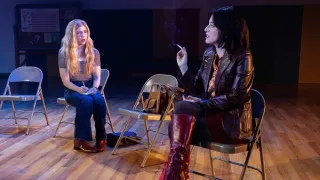
Alex starts trolling the baby black market on the Internet and connects with Nerine, a newly pregnant, desperate young woman, possibly a junkie (she smokes incessantly when they first meet), looking to sell her baby. But, even though she clearly has no room to judge anyone, she almost shuts down the deal when she finds out that this is a gay couple.
As the baby grows inside her, she seems to grow into maturity to know that she could grow into such a mature decision, whatever her original motives, of having her baby and ultimately providing a secure, loving home with Alex and Steven.
Alex is so happy; he quits his job with a design firm and starts his own company so he can work at home. Steven still plays the straight stud at work and is still canoodling on the not so sly. Baby Sam is born, Nerine gets her payment for delivering a healthy baby and the men adjust to joyous fatherhood.
Everything seems dreamy for Alex and Steven, too dreamy. When Sammy is a toddler, Nerine contacts them, she is strung out and back with an abusive boyfriend Bob. They are clearly using and desperately confront the men in a blackmail scheme for cash flow and threaten to out Steven to the media, as well as expose him exploiting a desperate young woman through the internet. Emotional mayhem ensues.
Well-known Australian actors Graeme Squires and Nicholas Gunn have, to say the least, smoldering chemistry as Steven and Alex and don't hold back emotionally even with some of the story's predictable heavy-handedness. Jessikah Brown is the alternately selfish and selfless unequipped mom in an abusive, addictive driven bond. All three leads particularly build their characters as much between the lines as they do with some of the stagey dialogue.
Stylish cinematography in some great locales by Michael Schoell, not to mention the sex scenes that will no doubt make it a cause for controversy for its general release, but will be deservedly lauded by GLBTQ audiences for the film's frankness.
Julia Britton's original play and the film's screenwriter Angus Brown pack "The Dream Children" with plot tangles, but smart, stylish direction by Robert Chuter keep it from being an overwrought soap opera. Chuter's ambiguous ending unexpectedly hints that not everything is neatly, and certainly not emotionally resolved, which strikes a key of truth about all relationships.