August 4, 2015
Original Practice Shakespeare Romeo and Juliet
Meg Currell READ TIME: 6 MIN.
When my husband suggested we go to a late-night Shakespeare in the park production of "Original Practice Shakespeare Romeo and Juliet," I dragged my heels. Not for disdain for Shakespeare, nor for parks in general (which might get me kicked out of Portland), but because I had recently seen "Macbeth" in the park (well, cemetery, but stop splitting hairs) and don't like to repeat experiences.
Did I NEED to see yet another iteration of rhymed-couplet set to the beat of mosquito swatting? Was there a good argument to leave my comfy air-conditioning at 10 p.m. to go sit on the grass and strain to hear actors who delivered their lines to the scenery? Would I be glad in the morning for having gone to bed at 2 a.m. after watching a couple of overwrought teenagers kill themselves because their families couldn't get their shit together and act like human beings?
At 8:30 p.m. on Saturday, I realized that my husband wanted to go out with me on a full moon and watch "Romeo and Juliet," one of the most famously romantic texts of all time, and that I was being an idiot. So we packed our pick-inick basket and away we went.
Laurelhurst Park provides a beautiful -- if hilly -- venue for late-night theatre. Perched on the top of the north-most shoulder of the park were two tents of the backyard-barbeque type, draped in velvet to assert that Something Serious was about to happen here. Klieg lights washed the stage area, powered by generators nestled behind the firs. Behind the audience flopping area was a table lit by a lantern, where you could purchase beer and wine and water, and pick up tiny bubble bottles. This, I thought, was a good sign. Bubbles? Hell yes.
A man in cargo shorts (not a costume) came to the front and introduced what we were about to see. He gave us guidelines, reading off a ridiculously small piece of paper that, curiously, he did not unfold for ease of use. He explained that the actors in the troupe receive, on these scrolls (oh, it's a SCROLL! I see), their own lines and cues only, given the last four syllables of the cue-line before their line. Once they hear those syllables, they know it's their turn.
He also introduced the referee, dressed in the black and white uniform, who looped through the crowd high-fiving everyone, whistle in his mouth and a headlamp on his forehead. He was to act as a prompter in the event an actor dropped a line, but he also had some guidelines. He encouraged us to cheer for boobies (or women's rights to bare breasts) and boo the patriarchy.
Oh, I was so in.
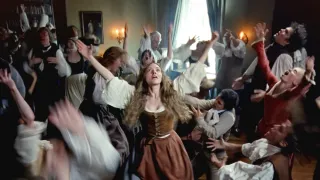
The two Montagues who start the action set the tone for the whole show. Bawdy, drunken, carefree and youthful, they reveled in the freedom of acting just as they pleased, unfettered teenagers tasting life for the first time. And so it was for the cast; fully loose and ready for anything, they danced along the text but truly delivered their characters through action and gesture, inflection and tone. Given direction by the words, they moved gaily through the story, as fully immersed in what they were doing as any actors I've seen on any stage.
Of particular vigor and skill was the actor who played Mercutio, Brian Allard, who pushed well past any boundaries of good taste in his performance and provided a deliciously, fantastically outrageous and barely lovable character who drives most of the action in the show. With his costumes of jeans and suggestive t-shirts, leather pants whose fly opened to reveal a black strap-on dildo to punctuate the intensely penis-centric text, and an umbrella for a sword, Allard's Mercutio was perfectly, drunkenly, viciously funny.
A word about the costumes. It appears the actors threw together costumes of their own devising, with Montagues veering toward gray tones and Capulets toward red and black. There were jeans and t-shirts, flannel shirts and leather pants, shorts over ripped black stockings, Mohawks, pants overstuffed with fake penises, and capes. Oh, the capes. So wonderful, so character driven, so appropriate.
This is the only "negative" thing I have to say about this production: it seems that "Red and Black vs. Gray" is the standard for "Romeo and Juliet" productions, and I have no idea why. Just once, I'd like to see other colors. Or no colors! Maybe the audience could figure out the teams without uniforms.
The ref helped the pace of the show, sometimes moving along line-delivery when the space between cues was getting too long for his taste. He occasionally whistled in a break in the text, asking the players to explain what happened, or offering a suggestion to the actors.
When Romeo entered, the first time we saw him, he was finishing a 40 oz. beer, just ending his long night on the town whining about Rosaline. The audience started chanting "Chug! Chug! Chug!" which he did, and then the ref whistled and instructed Romeo to play the rest of the scene as a drinking game: anytime any character said the word "love," Romeo had to drink.
Good thing it was a 40 oz.
Thanks to the ref's whistles and instructions for improv scenes, we were treated us to Mrs. Capulet's favorite story about Juliet as a child, to the background story that caused the Montague/Capulet feud (something about what Capulet was doing to sheep when nobody was looking) and Romeo, whose mask for the ball was a child's Batman costume, delivering his Juliet-wooing lines in his best Dark Knight voice.
Romeo, played by Michael Kutner, was oozingly whiny, exactly as Romeo should be. I wanted to smack him for being such a stupid teenager. Juliet, played by Sarah Jane Fridlich, was a spazzy, wide-eyed, rainbows-and-unicorns chatterbox; through her, I "got" Juliet in a way I haven't before. She's 14! Fourteen-year-old girls are really, really immature, and Frindlich played this precisely and divinely. She (as is Allard, for that matter) is one of those actors you can't take your eyes off of.
There were so many amazing performances in this show it's impossible to name them all without having the readers become numb to my effusiveness. Heidi Hunter's Tybalt was fascinating; not just aggressive, but conflicted, as if she knew she was supposed to hate the Montagues, but when she acted on the hatred, was afraid she was doing the wrong thing. It encapsulated the whole issue of the play: crossing lines that don't make any sense in the first place.
The Nurse, played by Sara Fay Goldman, was delightful with her broad New Jersey accent; I could see those "Real Housewives" in her gestures and inflection. John Bruner was excellent as Capulet, the smooth-talking head of household who ruled his women behind closed doors with abuse and violence.
Even the Frier who unwittingly escorts the couple to their deaths, played by Keith Cable, was the source of delighted laughter and hushed attention. He will live on in my memory as the only actor to ever break character to explain his fumbled approach to the stage with the apology, "I'm a little baked." Nicely done, Cable.
Thanks to OPS Fest, I saw this play that I know almost by heart in a completely different light. From the minor parts to the top two names, every cast member was played with the excitement and humor and freewheeling energy that I have dreamed were hallmarks of the original performances of these plays. They were performed, in that day, not for the upper class, but for the poor, the uneducated, a relief from the drudgery of daily life, a chance to drink and laugh and escape life for a night.
And OPS provides that escape in their wild, audience-participation fuelled gambols in the darkness of Portland's numerous parks. This is a joyride you do not want to miss.
"Original Practice Shakespeare Romeo and Juliet" ran through August 1 at Laurelhurst Park, Cesar Chavez Blvd, Portland. For tickets and information for upcoming performances by OPS Fest, call 503-479-5677 or visit http://www.opsfest.org/ for tickets.