September 25, 2015
Talking with 'Stonewall's' Breakout Star Jonny Beauchamp
Frank J. Avella READ TIME: 8 MIN.
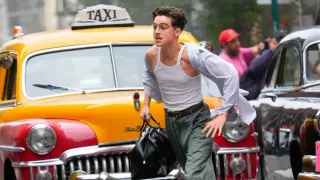
There's a devastating hotel room scene in Roland Emmerich's new feature "Stonewall," where the androgynous hustler Ray/Ramona, played by Jonny Beauchamp, has just been physically and sexually assaulted. It's a tipping point for Ray. He's always been a dreamer, but now he's seeing things in a more fearfully realistic manner.
"That was the one scene I was most nervous to shoot," Beauchamp shares. And it's one of the most painful moments to watch, because Beauchamp is so fully immersed in Ray's anguish that it's impossible not to be affected by it.
"It was cold, I was in my underwear... I stayed on this bed for a few hours, it was so hard," Beauchamp recalls. "But you have to be mean to yourself and reduce yourself to nothing. It was challenging."
To say newcomer Jonny Beauchamp was up for the challenge is an understatement. He's the heart of the new film in theaters this week. His character's journey best personifies the plight of the marginalized: Those gays, lesbians and gender non-conforming people who had to fight tooth and nail to be respected, and are still fighting for basic civil rights.
I sat down with Jonny at the Stonewall Inn on Christopher Street where history was made 45 years ago and found him to be a charming, intelligent, intense and focused actor, excited about what his future holds and not afraid to speak his mind.
The driven and confident actor was excited about playing Ray from the get-go. "When I read the script (by Jon Robin Baitz) I thought, 'This character is like Hamlet. Ray is funny. Ray is fast. Ray is powerful. Ray is vulnerable.' I never had the luxury of playing a character that was so fully fleshed out before."
Ray's Unrequited Love
Beauchamp won the role despite being a virtual unknown. ("Stonewall" is his first feature film role.)
"I owe everything to Roland," Beauchamp gushes. "He cast me from the masses. Some people said not to cast me because I had nothing under my belt, but he refused and said he had to have me in the film."
The film follows the odyssey of Midwestern born Danny (Jeremy Irvine), who is kicked out of his Indiana home and travels to Greenwich Village in the Summer of 1969, where he finds a surrogate family of "deviants" led by Ray. The two boys form a bond that anchors the film.
"Ray has such love for Danny because of his otherness," Beauchamp expounds. "Even though Danny's from Indiana, Ray sees him as being off the bus from 'Kansas' (a reference to Ray's idol Judy Garland's most famous role in "The Wizard of Oz."). It's Danny's vulnerability and pureness that he is drawn to. Ray's been on the streets since he was 12, and Danny's just this beautiful optimistic 'ray' (he's drawn to). Danny's educated. He's going to Columbia University. Ray doesn't know anybody who's gone to Columbia. His biggest dream is pharmacy school."
Asked about the unrequited nature of the relationship, Beauchamp says: "I think it makes perfect sense why Ray would fall in love with Danny. And I think it also makes sense why Danny doesn't feel that way for Ray. Danny comes from a different place, and Danny wants different things. That's not to say he doesn't love Ray, and not to say that he doesn't have a deep bond with Ray. They become family, which is beautiful. They're lifelong friends. It's a moment in time that will never die."
The character of Ray is a composite of real Stonewall figures. One of the names most bandied about is Ray Castro, a baker who was arrested during the event and has come to be seen as one of the heroes of the movement. The second figure is the "incomparable" transgender activist named Silvia Rivera, whom Beauchamp had studied as an undergraduate.
"I was a gender and sexuality minor in college, so I was a little bit more privy to the Stonewall movement and the key players (than other cast members). Silvia Rivera was very much an activist, and very much a part of the 'Street Queens.' The script kept shouting to me: Silvia Rivera and her radicalism was very much part of LGBT movement at that time."
A Collaborative Effort
What surprised Beauchamp was the level of camaraderie he found on the set. "There was a real sense of collaboration, which is not always a luxury new actors are afforded. And all of us meshed so well together. I've never worked on a project where I am so still in contact with everybody.
"Roland was really interested in what we thought and how we felt about things," he enthuses. "We would take his direction and shoot things as is and then he would give us some room (to improvise)."
To illustrate this point Beauchamp recalls a scene in the Stonewall where Trevor (the Mattachine Society official played by Jonathan Rhys Meyers) dances with Danny, much to Ray's chagrin.
"I could tell that Roland wanted something really specific. I knew what it was, but I wasn't able to give it to him. So we shot a few takes." Still, the scene didn't work.
"Then," he recalls, "I asked if I could just do one take where they actually play the song (Procol Harem's 'A Whiter Shade of Pale.') And Roland said, 'absolutely.' So we did it with the song - Jonathan went through the motions with Jeremy, and I had this tearful moment that Roland really wanted. I knew I could give it to him, but I needed to be in the world with the sound. That goes to show you with a little bit of collaboration you can really go a long way."
Raised in New York City, Beauchamp moved upstate with his mother to get a better education. "That was the best thing that ever happened to me, because I learned to speak more eloquently. I learned to read with more understanding, which was a skill I didn't have until I moved to Rockland County. And then I saw the movie 'Fame' when I was 14, and I begged my mom to let me go to that school."
That proved quite the savvy move. "I was very serious about things very early. I knew that this was real. And so I moved to New York City and got into that high school. And a lot of my friends had managers and were working, so I was really immersed into that world early. And I realized you have to be on your shit 100% every day. You never know whom you're going to meet. You never know where a project can take you."
A Bit of Trouble
It was an off-off-Broadway revival of Stephen Adly Guirgis's "The Last Days of Judas Iscariot" during a month off from college that got him noticed by a "Pinkalicious" casting director. He won a role in the popular children's musical, which led to workshops and more gigs.
"I got a little bit in trouble in school for working outside (of Marymount Manhattan College), missing a class here or there; but I was like, 'This is my education, and this is my time, and I just don't want to stay in a studio for four years and not actually do anything.' And it worked in my favor."
The ambitious Beauchamp seems to know himself pretty well. "I need to practice. Some people learn so much from class and from reading, but I need to be onstage. I need to be working and honing my skills. I was young, and the more I could do the better, so I was always juggling projects."
He's going to have to become a better juggler after "Stonewall" bows. He already did a major stint on the second season of Showtime's macabre Victorian melodrama "Penny Dreadful" as the transgender (before there was a word for it) Angelique, where he made headlines for going "full frontal." No surprise, since the actor is pretty fearless and rightly proud.
Beauchamp has been quite open about his own sexuality. "I don't apologize for who I am," he emphatically states. He foresees a time in the near future when questions about an actor's orientation won't need to be asked.
"I do think with the next generation, this one coming up, sexuality is a lot more fluid. And I do think there are a lot less hang-ups about who people want to sleep with. It's more taking people as people, which is awesome and I think it's only going to move forward."
He adds, "I think it's shameful we have only a bit of trans-visibility, in media, in society. I think that's the frontier that needs to be pushed towards the furthest right now. We need more trans visibility in art, in commercial projects, in politics."