October 15, 2015
Back to 'Big Eden' :: Recalling The Classic Film 15 Years Later
Frank J. Avella READ TIME: 8 MIN.
"You have a baby, and then it goes and lives a life. I'm just so grateful other people like my kid," muses Thomas Bezucha on the lasting impact of his first feature, "Big Eden." "I feel strangely separate from its success. I'm happy that there was something in the spirit of my wish for a more inclusive world that resonates with other people."
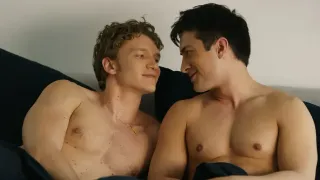
The now-classic LGBT film has been newly restored to HD with a gorgeous digital transfer from the original 35mm negative. It is now available on Blu-ray for the first time, as well as a new VOD version, courtesy of Wolfe Video. The release also includes a terrific featurette with interviews with the filmmaker and key players reminiscing on making the movie, which won a slew of Film Festival Awards back in 2000 and 2001.
"Big Eden" is a fable of sorts, set in a small Montana town. Henry Hart (Arye Gross), a thirtysomething Manhattanite artist, moves to his hometown of Big Eden to care for his ailing "Sandpa" (Grandpa Sam -- played by George Coe) and finally come out to him. Henry reconnects with his old high school crush, Dean Stewart (Tim DeKay), who is still handsome and in remarkable shape. Dean is recently divorced, and Henry's twenty-year-old torch is rekindled. Dean doesn't help things by leading Henry to believe a relationship is possible.
A Magic Touch
Big Eden (the place and the pic) is peppered with loving and respectful townfolk who look after one another and are truly accepting. One of its citizens, Pike Dexter (Eric Schweig), is secretly in love with Henry, but is too shy to tell him; so instead, he cooks for him.
Bezucha handles his nuanced characters and mosaic-like film with a magic touch that foresaw today's transformed LGBT culture fifteen years ago. I spoke to the writer-director recently about his achievement.
"I wanted to make a movie about gay people that you could sit down and watch with your grandmother," Bezucha imparts. "And that she would root for the gay people to end up together. That was definitely my mercenary task.
"I also felt that the most radical, political thing you could do as a gay person was to be visible. You had to be out. That's Henry's struggle in his coming out to his grandfather. And he fails. He doesn't manage to do it. Even though the grandfather was practically begging him to tell him. So I wanted that to be a cautionary tale."
About Kim Davis
Relatability was always part of the Bezucha's plan. "I always felt that the more the straight community was able to understand that their brother, their nephew, their uncle, their cousin Phil, the nice mailman, that those people were gay -- once you know somebody, it's harder to say, 'the gays.' It's cousin Phil. And I really feel that in all of the dust up around Kim Davis, it isn't so much civil rights, but once people understand that a member of their family or extended family is gay, they perceive an innate unfairness about that person being treated any differently.
"What's interesting about the Kim Davis thing is that people are coming to the defense of gay people. That what she's doing is so unfair."
Not surprisingly, Kim Davis makes her way into yet another conversation about acceptance vs. intolerance.
"I feel badly for how clouded her thinking is, and I don't think she probably has a very happy life... I am fascinated by the politicians that align with her, her terrible lawyers, all this bullshit with the Pope. She's just a great fulcrum from which all of this stuff is spinning right now... I think people see the plain unfairness of what she's done, and that's what they object to. Whether you support gay rights or not, people understand unfairness."
The Opposite of 'Brokeback Mountain'
Bezucha did not start out in movies. He served as VP of Creative Services for COACH and before that worked as Senior Director of Creative Services for Polo/Ralph Lauren for eight years. So how did he become a filmmaker?
"I was living in New York," he explains. "I worked for Ralph Lauren and valued my job. But I think I just really wanted to be making movies. I really wanted to change my life. And I suddenly fell in love with the West. It was a bunch of things at the same time. 'Thelma and Louise.' I discovered Dwight Yoakam. I read a book called 'The Great Plains,' by Ian Frasier. And I was sent to Cody, Wyoming, for work, which is where Buffalo Bill had his summer camps, in the middle of nowhere.
"So I fell in love with the West. And developed this fantasy that I was going to move there. 'I'll teach art in an elementary school.' And I would tell my friends, and they would get apoplectic. 'You can't do that!' Because I was gay. I was amazed how they already decided what the experience would be like. And I believed people are good and nice.
" 'Big Eden' was the opposite version of what people were afraid of. It's the opposite of 'Brokeback Mountain.' I wanted to make a gay movie where somebody lived, somebody found love and was able to live."
Casting Louise Fletcher
The first time director wrote a draft and shared it with some people, including the eventual producer, Jennifer Chaiken, who eventually found financing (a little over $1 million), and Bezucha was able to make his indie.
One of the coups was signing Academy Award winner Louise Fletcher ("One Flew Over the Cuckoo's Nest") to a featured part.
"She was in Natalie Wood's last movie, 'Brainstorm,' with Christopher Walken," Bezucha recalls. "She played a scientist who is nice. And I just fell in love with her. She has a couple of vulnerable scenes in the movie, and she isn't the Nurse Ratched villain she usually gets cast as. And she smiles in it, and I remember thinking, 'I am going to write a movie where Louise Fletcher gets to smile.' So I wrote that part for her. When we were getting ready to cast, somebody met somebody who knew somebody who knew Louise. And we gave the script to that person and -- it was amazing -- a week later my phone rang, and I picked up, and it was Louise Fletcher and she said, 'I loved your script, I'd love to do your movie.' So I get to take that away with me all the way to the end."
Food and Sex
The most fascinating character in "Big Eden" is Pike, played winningly by Eric Schweig. Pike is that rare film character who is Native American, in love with another man, and there isn't an ounce of anything stereotypical about him.
"In my imagination, Pike was partly Native American," Bezucha says. "When it came down to the casting, I felt strongly that it had to be a Native American actor. The idea of casting a non-Native American actor in even a partly Native American role was offensive to me."
One of Pike's greatest characteristics is that he enjoys cooking for Henry. It's the way he expresses his feelings for him. Bezucha was influenced by one of his favorite films, "Babette's Feast," where "love is expressed through food."
As to Pike's sexuality, Bezucha wonders himself: "Did Pike identify as gay? I'm not sure. But he loves Henry. He is in love with Henry. One of my favorite scenes in the movie is with O'Neal Compton, who played Jim, essentially asking Pike if he's gay. And I love the way they dance around it. It's very sweet and very generous."
A Holiday Favorite
Five years after "Big Eden," Bezucha would make what is becoming a holiday favorite, "The Family Stone," starring Diane Keaton, Rachel McAdams, Sarah Jessica Parker, Claire Danes, Dermot Mulroney, Craig T. Nelson and Luke Wilson. It was a project inspired by the Thanksgiving scene in "Big Eden."
"As a writer, what I love about it is that there's no dialogue. But at that point in the movie you know everything that's going on with everybody. So it's funny to watch them looking at each other. So I built 'Family Stone' out from that dinner table scene."
"The Family Stone" proved another wonderful experience for Bezucha: "We shot 'Family Stone' almost chronologically, which is unusual. So two-thirds of the way through the shoot we got to that scene (Christmas dinner, this time). We were in that dining room for four days shooting, and I thought they were going to be so bored. We broke for lunch on the third day. And they went to the soundstage next door where there was catering, and I looked in and all of the actors were sitting in exactly the same positions that they were sitting in in the dining room. They all loved each other so much. And they kind of stayed in character the whole time. It was fantastic. And very unusual."
Only Three Films?
To date, he's only made one other film, 2011s "Monte Carlo," with Selena Gomez, Leighton Meester and the late Cory Monteith.
When asked why he's only made three films he responds, "I should maybe write more movies about superheroes or 300-foot robots. Maybe I would get more movies made. It's hard. I like telling stories on a human scale and it's hard to demonstrate that those make money now."
Bezucha is working on a project with Maria Maggenti, the writer-director of "The Incredibly True Adventure of Two Girls in Love."
"We were both arrested in ACT-UP back in 1989," he confesses. "We're collaborating on a gay, little bit of a tear-jerker, little bit of a comedy set in the '80s. It's interesting to work with somebody and remember what it was like back then, and how..." He pauses, and then goes into his best old man voice: "The kids today can get married, they can go register at Restoration Hardware, the can have a baby."
He then returns to his regular voice, but now serious. "What happened to a butch dyke? Or a faggot? I don't hate that word. I like 'queer.' I sometimes miss a counterculture. I don't know if we all fought to be Donna Reed."
It's definitely a point to ponder, from the man that gave us a fairy tale world fifteen years ago that appears to be coming true all around us.
Big Eden is available on Bluray and VOD from Wolfe Video. For more information visit the Wolfe Video website.
Watch the trailer to Big Eden: