November 24, 2017
Spike Lee Gives a Compelling Modern Makeover to 'She's Gotta Have It' for Netflix
Jason St. Amand READ TIME: 4 MIN.
Watching Spike Lee's first feature film "She's Gotta Have It" in 2017 feels just as groundbreaking and revolutionary as it must have felt when it was released in 1986. Far ahead of its time, the film offered a frank discussion about sexuality and relationships by a woman of color - the film's complicated main character Nola Darling (originally played by Tracy Camilla Johns). At a time when sexual assault and harassment against women is at the top of the nation's mind, Lee revisiting his first joint and molding it into a 10 episode series for Netflix, strategically debuting on the streaming service on Thanksgiving, makes for a compelling watch.
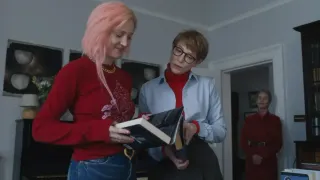
Lee, who directs all 10 half-hour episodes, gives "She's Gotta have It" a complete modern makeover, breathing new life into his project. Still set in Brooklyn's Fort Green neighborhood and still centered on the life of Nola Darling, this time played by newcomer DeWanda Wise, the Netflix series proves Lee has a lot on his mind and has a lot to say since the film's debut over 30 years ago. Like the movie, the show follows Nola, now an artist who has a number of side jobs to afford her pricy rent, as she has relationships with three men (and a woman), including the sophisticated and well-to-do businessman Jamie Overstreet (Lyriq Bent), the handsome and narcissistic photographer Greer Childs (Cleo Anthony) and the whacky and sneaker obsessed bike courier Mars Blackmon (originally played by Lee and now played by the wonderful "Hamilton" star, Anthony Ramos).
The series is not a cash-grab reboot for Lee, who is the latest prestigious filmmaker to cross the movie-to-TV line. "She's Gotta Have It" is a thoughtful examination that works on a number of levels: It's fascinating retooling and re-contextualizing of an artist's own work and it taps in to the zeitgeist, providing fresh perspectives and new kinds of stories on TV. It also eerily echoes today's ongoing outpour of allegations of assault from women, making "She's Gotta Have It" a poignant and relevant series.
A few years ago Lee confessed in an interview with Deadline that his "biggest regret" as a filmmaker is the rape scene at the end of his 1986 film in which Jamie (originally played by Tommy Redmond Hicks) rapes Nola.
DeWanda Wise and Anthony Ramos in Netflix's "She's Gotta Have It." Photo credit: David Lee/Netflix
"If I was able to have any do-overs, that would be it. It was just totally... stupid," he said. "I was immature. It made light of rape, and that's the one thing I would take back.
"I was immature and I hate that I did not view rape as the vile act that it is," Lee added. "I can promise you, there will be nothing like that in 'She's Gotta Have It,' the TV show, that's for sure."
Lee made good on that promise from 2014. A stranger on the street assaults Nola in the show's first episode but the incident serves a bigger purpose, becoming the catalyst for Nola's character development as a feminist and artist. It forces her to examine her life, her artwork and how the men she's with treat women.
The millennial Nola is as sex-positive, bold and confident as her1986 counterpart. She refuses to be tied down to one man, as she gets different things she needs from the three, very different, suitors in her life. She's also unabashedly queer and develops a fulfilling relationship with a woman in the series.
"As a sex positive, polyamorous, pansexual, words like monogamy have never even seemed like a remote possibility," the new Nola says in episode four.
Nola's outlook on life is simple and echoed in the movie/show's title: She wants to do what she wants, when she wants and on her terms. For Nola, it's simple. For everyone else it's not. This disconnect is the source of most of the drama and tension in "She's Gotta Have It." We mostly see everything through Nola's eyes but she's not always in the right and her actions do have consequences, impacting the people around her.
DeWanda Wise in Netflix's "She's Gotta Have It." Photo credit: David Lee/Netflix
With more than five hours to play with (the film was 90 minutes), Lee is able to flesh out the characters in the "She's Gotta Have It" universe. Viewers will get to explore the lives of her suitors, giving them a deep complexity that provides gravit to their actions and how they treat Nola. Lee also finds time to take down the gentrification of Brooklyn, or as how one of Nola's friends puts it, "hipster imperialism."
But like the film, "She's Gotta Have It" the TV show is a shaky at times. Lee goes very wrong with a subplot involving a friend of Nola, who is a waitress at a dance club and undergoes dangerous filler injections for her butt. Additionally, some of the writing is awkward and forced, resulting in stilted performances: Lee sometimes uses Nola as a mouthpiece and in the TV show, she's a cinephile, often spewing Oscar statistics and dropping names of obscure directors. It's an obvious gimmick that doesn't work, creating a jarring experience within episodes. Nevertheless, the good outweighs the bad here and Lee's revisit to his debut film is an interesting venture, full of strong performances and his unique directorial skills. Still photos and album covers are used to cut scenes, adding a deep context to an already emotional story and Lee films New York City with a tender love.
"She's Gotta Have It" offers an expanded look at Lee's first film and happens to debut at a fascinating time. The show may feature a number of men, but this is Nola Darling's story - a powerful and uncompromised point of view, still daring in 2017 as it was in 1986.