December 18, 2019
Expansive 'Moby-Dick' is Great Musical Theater
Robert Nesti READ TIME: 7 MIN.
It's funny how two of the best entertainments available this month around Boston are both three-and-a-half hours in length. One is a film, Martin Scorsese's gangster drama "The Irishman," available to anyone with a Netflix subscription; but the other, the new musical "Moby-Dick" at Cambridge's American Repertory Theater through January 12, may be a little more difficult to see. Many performances are sold out between now and its closing. And, in terms of length, we can only hope either doesn't start a trend.
But I can't imagine any fan of musical theater wouldn't jump at the chance to see this expansive adaptation of the Melville classic, which tells the story of Captain Ahab and his destructive pursuit of the great white whale that robbed him of a leg that also acts as a running commentary on it. Especially since it marks the collaboration between composer and lyricist Dave Malloy and director Rachel Chavkin, whose previous work with the theater was the splendid "Natasha, Pierre & The Great Comet of 1812," another heady adaptation of a 19th century novel.
In that earlier show, Malloy only took a portion of Tolstoi's "War and Peace," here he takes on the entirety of Melville's novel, then gives it a 21st century spin, which no doubt contributes to its length. It is also wildly digressive and chance taking. What else can be said about a show in which one of the novel's more mysterious characters, the Pharsee prophet Fedallah (a show-stopping Eric Berryman), gets a 10-minute speech in which the actor breaks the fourth wall and addresses his issues with Melville's conception of him (as well as with the director and writer)? Or production numbers dedicated to the many kinds of whales there are (augmented with some fantastic puppet representations of them designed by Eric F. Avery) and why whale meat really isn't a gastronomical delicacy. (Too fatty, too rich.)
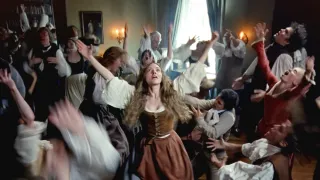
And just when the show is about to go off the rails, along comes another great Dave Malloy song or another bit of Chanel DaSilva's vigorous choreography that pulls you in again. Even a respite between the first and second parts, when audience members are recruited to be part of the action, yields a great theatrical dividend when those volunteers go on a whaling trip, replete with sperm whale spouting water. The moment, with four whaling boats filled with red-jacketed audience members and the seafaring cast singing a full-bodied sea chantey, is just one of the thrilling tableaux that Chavkin and her collaborators come up with in staging sequences from Melville's book.
As with "Natasha, Pierre & The Great Comet of 1812," the design elements – again by Mimi Lien – are integral in creating a space in which the audiences bonds with the action occurring around them. She set the show in a skeletal, interior of the Pequod, given a metaphorical nod in the opening number when a preacher in a hoop skirt climbs up in a crow's nest and tells the story of Jonah and the Whale, telling the audience that "we are all in the belly of the beast." Visually we feel it. Lien's designs are both epic – encompassing oceans and the beasts that live within them – and intimate, thanks to a thrust stage that extends well into the Loeb, putting the audience on three-sides and the actors often so close they can be touched.
That intimacy extends to the story telling as well, which takes a meta-approach to Ishmael (Manik Choksi), the book's narrator. Here is a sweet-natured Millennial who confesses to having a rough couple-of-years and takes solace in his favorite book, which he and the company act out. What follows pivots between long, musicalized sequences from the novel that follow the Pequod on its three-year journey in search of Moby Dick and commentary (usually by Ishmael) that looks at the novel with 21st century views on racism, class and the environment. Malloy and Chavkin are clearly on the sides of the whales in this man vs. nature dynamic: the only times there is peace is when the two sailors on watch listen to the whales, exquisitely realized as part of Malloy's soundscape, suggesting a serenity interrupted by the whaling industry.
There is so much to take in that "Moby-Dick" is feels impossible to give it its full due on a single visit. And while the length may be a dealbreaker for some, it flies by due to the synergy between Malloy's inventive, infectious score and Chavkin's dynamic staging. Here Malloy trades the Russian-inflected sound he used for "Natasha, Pierre & The Great Comet of 1812" for a 19th century New England one, shading the score with sea chanteys, Protestant hymns and folk songs (as well as 20th century jazz and show tunes) filtered through his pop sensibility. As he has shown in the past, most notably with "Ghost Quartet," Malloy is a master of choral writing, which is quite gorgeous throughout. The expert musical direction and supervision is by Or Matias, with pianist J. Oconer Navarro conducting the nine-piece band.
The show falls into four parts: the first introduces Ishmael and the crew as they sat off on the voyage. How he bonds with Queequeg, the tattooed-face, expert whaler from the South Seas, makes for one of Malloy's funnier numbers; and the homoerotic nature of their relationship is nicely textured in. It takes some time for Captain Ahab (a magisterial Tom Nelis) to make his appearance, but when he does he commands with his hard, Puritan demeanor and booming baritone, put to good use in sequences that recall Sondheim's "Sweeney Todd." The second part feels lighter and looser, thanks to the volunteers from the audience taking part in the action; and by Ishmael running through what he considers the boring parts of the book.
After intermission, death and obsession take over, death with a prolonged section depicting the death of Pip (a touching Morgan Siobhan Green), the cabin boy who goes mad then drowns when he jumps ship on a whaling trip, then obsession with Ahab's three day assault on Moby Dick that ends (spoiler alert) with the destruction of the Pequod with Ishmael its only survivor. The dramaturge in the second half could use some refocusing and clarification, so a tender moment between Ahab and Pip would make more sense; and what is Ishmael's back-story? It is only hinted at. Nonetheless, "Moby-Dick" makes for compelling musical theater – at times soaring with operatic fervor, at other times, just silly fun; and in deconstructing the novel's 19th-century attitudes through a 21st century prism, it makes for a far richer retelling of Melville's story.
The hard-working cast, who appeared to have trained on a real whaling vessel of some sort, is terrific. With Ahab, Malloy has written a character of a "Sweeney Todd"-like scope, and Nelis has both the physical and vocal gravitas for the role. Manik Choksi makes for a most convivial Ishmael who (acting as Malloy's avatar) brings the audience into the world of his favorite novel. That we never know the personal details he alludes to for his finding solace in Melville is never fully explained, but that would probably lengthen this already long show. I did, though, want to know more about him. What is nicely textured into the story is his intimacy with Queequeg (Andrew Cristi, excellent), the tattoo-faced, South Seas islander onboard for his superior whaling skills, who becomes his bunk mate (and soul mate).
Stephen Sondheim once called "Follies" as an "embarrassment of riches," a description that fits this show at this point in its run. Though not quite fully realized, "Moby-Dick" is invigorating musical theater that is spectacular in execution. It is the kind of show that at some future date you can be happy to say that you were lucky enough to watch it, especially since it may be just too rarified for another commercial run.
"Moby-Dick" continues through January 12, 2020 at the Loeb Drama Center, 64 Brattle Street, Cambridge, MA. For more information, visit the American Repertory Theater website.