April 13, 2022
Review: 'Russian Doll' Even Trippier in Season 2
READ TIME: 3 MIN.
Natasha Lyonne returns as the raspy-voiced, constantly wisecracking, and cosmically tripping Nadia Vulvokov in Season Two of "Russian Doll."
The metaphysically comedic series, which streams on Netflix, started out in Season One as a "Groundhog Day"-style story of a repeating day in which Lyonne's Nadia kept getting killed – first hit by taxi cab, then falling down stairs, then on to all sorts of gruesome fates. During a fatal elevator plunge Nadia met fellow repeater Alan (Charlie Barnett), who had committed suicide by throwing himself from a rooftop. He, too, kept ending up dead and re-starting the sequence of his final moments, only to die all over again in various ways. Puzzling out why they are trapped together in the loop, the two finally managed to break free.
If the end of Season One, with its celebratory, oddball parade, seemed like a good way to send Nadia and Alan off into the afterlife, think again: As Season Two commences, it's four years later and they've both managed to lead normal lives in what seems like the ordinary, workaday world. Nadia looks both ways before crossing the street; Alan, ever the fussy perfectionist, suffers his mother's romantic advice as he endures an endless string of dates, hoping to find someone he'll be compatible with. Everything gets weird again when Nadia rides the Number Six subway train to an unexpected destination.
Avoiding spoilers, let's just say that a mystery concerning Nadia's mother –�and her mother's fraught relationship with Nadia's grandmother – yields a succession of new revelations and questions, many of them having to do with a stash of gold Krugerrands (the family's hedge against the inevitable day when some fascist monster in the mold of Hitler rises to power once again). There's some clue-tracking, some globe-hopping, and a whole lot of not-so-easy-to-follow faux physics and barely-explained metaphysics, and a bunch of leaps in narrative logic, but nothing that you can't dismiss or accept with one of Nadia's own favorite expressions ("Eh"). The series barrels along, and the meaty stuff (Nadia's complicated emotions regarding her imperfect family life and lineage) is served up with a sometimes surprising blend of ruthlessness and poignance.
As was the case in Season One, Charlie gets short shrift, and is barely even seen until Episode Four. In fact, Charlie gets even shorter shrift this time around, playing a substantial role in only a handful of the season's seven episodes.
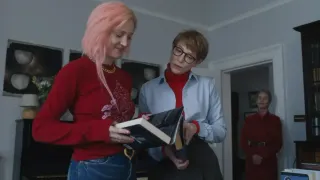
But where Charlie Barnett fans will feel a little disappointed, the series makes it up with a posse of absolutely kick-ass female characters, including Nadia's best friend Maxine (Gret Lee) and her wife (Lizzy (Rebecca Henderon), along with Nadia's unofficially adoptive mother, Ruthie (Elizabeth Ashley). Her real mother (Chloë Sevigny) plays a part this time around, also.
When we do see Charlie's story, it's a similar (and separate) tale of coming to terms with familial traumas, centered around his Ghanian grandmother's stint in 1960s-era East Germany and the associations she had there with young dissidents. It's an underdeveloped arc, but there is, at least, a frisson of eye-opening romance between Charlie and a young German man whose life, alas, is destined only to "intersect" with Charlie's for a brief time. Questions, regrets, and unresolved feelings hang – if not over Charlie, then over the viewer, who might wish for an eighth episode, at least, if not more time in the existing seven for that story to given adequate depth.
But, eh, what are you going to do? "When the universe fuck with you – let it!" Nadia declares, and she's right to do so. The powers that be play their games, and there are worse ways to deal than Lyonne's signature dry wit. In the end, this is a story about the choices you make in life –�and Season Two makes it easy to choose to enjoy the ride.
"Russian Doll," Season Two, streams on Netflix starting April 20.