July 22, 2022
Review: 'Anything's Possible' has Subtle Messaging, Potent Chemistry
Kilian Melloy READ TIME: 4 MIN.
Young love, hormonal conflicts, and gender identity collide in Billy Porter's sweetly-told directorial debut, "Anything's Possible."
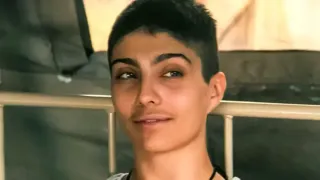
Kelsa (Eva Reign), an openly transgender high school student, maintains a YouTube channel in which she narrates her thoughts as she begins senior year. When she meets fellow senior year student Khal (Abubakr Ali) in art class, the attraction is instant, palpable, and mutual.
But both Kelsa and Khal have fleeting reservations. When Khal finds Kelsa's YouTube videos and realizes she's trans, he has a fleeting moment of shock (illustrated with a amusingly over-the-top animation), but what really concerns him is the likelihood that if he starts dating her, he might lose is homophobic best friend, Otis (Grant Reynolds).
Meantime, Kelsa is wary of boys who might fetishize her: "I'm worried about people only pretending to like me because they want to be woke or something," she narrates on her vlog. Anyway, she adds: "Why have a boyfriend when I have two best friends?" –�those two besties being the tough, self-assured Chris (Kelly Lamor Wilson, wonderful in her scenes and a little underused) and Em (Cortnee Carter), who, as it turns out, has been crushing on Khal.
Complications ensue when Khal eventually makes a gesture to show his interest in courting Kelsa, and Em takes this as a personal betrayal. Meantime, Otis, as feared, takes Khal's interest in Kelsa badly. ("He's a dude!" Otis exclaims angrily, one of several ways in which the film acknowledges and comments on the vast reservoir of distrust and misperception much of the world still has when it comes to trans people.)
News of the love match ricochets through the school via flurries of texts, most of them supportive; when Kelsa's protective mother and Khal's parents find out about the couple they, too offer their support (though in ways that are slightly cringeworthy, as when Khal's father exclaims to his mother, who worries that Khal himself might be trans, "I told you – he's just gay!" ...as though there were some continuum of shame and trans people dwelt on its lower rungs). Khal's younger brother, Arwin (Naveen Paddock, who brings comic electricity to the film in his brief appearances), is supportive, too, in a broader and less problematic way.
But there are schemes afoot, too, by those who want to sabotage the relationship, and they reverberate with the real-life legislative crisis that sees half the states in America attacking LGBTQ+ people, and especially trans youth, in an ongoing tsunami of bigoted legislation. Beyond that, screenwriter Ximena García Lecuona roots the film's cascade of complications not in the usual roundelay of half-truths and misunderstandings that are standard for rom-coms (though those tropes do show up here and there), but rather in the characters' own fears and traits. Kelsa's father has rejected her, and that accounts for much of her stubborn – sometimes too much so – self-reliance.
On a deeper level, the screenplay addresses complex struggles around identity and gender that society, as well as individuals, must contend with. It's upsetting to Kelsa that when people look at her, "all they see is gender," but it's also upsetting that she's cast, by some, as "brave" when all she wants to be is herself. (It's a little on the nose, but even Kelsa's college admissions essay, which she frets about through the film's first half, wants her to recount a challenge in her live that required personal bravery.)
Khal, too, has his challenges, with his parents pushing for him to attend a university out of state and follow a lucrative, well-respected profession – shorthand for how they've bought into the "model minority" paradigm, which Khal, in his Gen Z way, sees as unnecessary; he'd rather attend a local trade school. That, in itself, provides another promising avenue of character contrast and dramatic tension, since Kelsa is determined to go to college either in New York or Los Angeles, her mother's pleas for her to stay close to home notwithstanding.
In certain surface respects, "Anything's Possible" follows the standard rom-com tropes, with is main characters living affluent lives in bubbles of progressive-minded acceptance. But in more profound ways, the film breaks free of sugary fairy tale conventions, insisting on more authentic emotional truths than we usually see in movies about young love. But that's not to say "Anything's Possible" lacks for charm or delight; Porter brings small, but significant touches to the film (a couple of classmates who flutter around like butterflies in a mating dance; dots of purple, including Khal's jacket, that signal an essential assumption of inclusivity) that speak to the universality of love in all its many forms and combinations.
Most crucial, though, is the casting, which is absolute perfection: The chemistry between Reign and Ali is so unforced, and so potent, that you don't just believe that the characters are in love, you accept without reservation that they should be in love.
"Anything's Possible" streams on Prime Video starting June 22.