April 17, 2023
What to See at OUTShine Miami 25
Frank J. Avella READ TIME: 15 MIN.
Outshine Miami continues its trend of setting the queer stage for many of the films that will dominate festivals for the year to come and those works that will secure releases in theaters and on VOD and streaming platforms. The number of quality films featured speaks volumes to their selection process and diverse, yet discerning, tastes. Celebrating 25 years, OUTShine Miami OUTdoes itself this year (a grand feat), presenting a slew of challenging, provocative and exciting titles – over 50 features, shorts, and docs from all over the world.
The Fest opens with Andrew Durham's "Fairyland," starring Scoot McNairy, Emilia Jones, and Geena Davis, and closes with the French bonbon "Three Nights a Week," directed by Florent Gouëlou. Sicilian filmmaker Emanuele Crialese provides the Centerpiece, "L'Immensità," boasting another amazing performance by Penélope Cruz.
Tickets are available at at the festival's website.
EDGE sampled quite a few of the fab films that are screening, and has a slew of recommendations.
'Winter Boy' ('Le Lycéen')
Out filmmaker Christophe Honoré has consistently crafted unapologetically queer films that explore different aspects of gay life ("Love Songs," "Sorry Angel"). His latest work, "Winter Boy" ("Le Lycéen"), is one of his best, certainly one that is most resonant for anyone who has lost a loved one. This beautiful film's focus is on openly gay 17-year-old Lucas (an astonishing Paul Kercher) who, along with his close-knit family, must deal with the sudden death of his father. Lucas goes down a bit of a sexual rabbit hole and becomes enamored with his brother's roommate – his way of mourning. Honoré delves deep in his examination of the psychological effects of grief on a young boy... and his shattered family. Newcomer Kercher anchors the film in a beguiling turn that is grounded in feelings of pain, confusion, anger, and heartache at a time when the character is becoming a sexual being. The always radiant Juliette Binoche is poignant and heartbreaking as Lucas' mother, and Vincent Lacoste is spot-on as his frustrated brother. We've seen deeply personal films about loss before, but rarely through a queer lens and, rarer still, presented in such a frank and authentic manner. In French, with English subtitles.
'The Lord of the Ants' ('Il Signore Delle Formiche')
"Those who fight against monsters must be careful not to become monsters themselves."
–Aldo Braibanti
Acclaimed Italian filmmaker Gianni Amelio came out in 2014, rather late in life (he is 78) and has now crafted a biopic of playwright Aldo Braibanti, a prominent figure who went on trial because of his homosexuality in the 1960s. In making "The Lord of the Ants," Amelio directly examines Italy's deeply-rooted homophobia, exacerbated by both the Catholic Church and the fascist reign (condemnation and denial, respectively). This highly ambitious historical endeavor, like Austria's "Great Freedom" last year, shows just how malevolent a society and government could behave towards same-sex love. Luigi Lo Cascio perfectly embodies the tortured Aldo, and Elio Germano is superb as the journalist covering the case. The film's most deeply affecting and harrowing performance is delivered by newcomer Leonardo Maltese as a young man who is nearly destroyed by a mother and closeted brother's ignorance. When Maltese isn't onscreen, he is sorely missed. Interesting to note: The Italian government didn't have a law against being gay, since Mussolini insisted there were no homosexuals in Italy, so they needed to use the charge of "plagio," or moral subjugation, to condemn him. In Italian, with English subtitles.
'Drifter'
The very first shot in German helmer Hannes Hirsch's feature debut "Drifter" is of an erect penis being masturbated. Way to hook your gay audience. Twenty-two-year-old Moritz (Lorenz Hochhuth) and his hot beau Jonas (Gustav Schmidt) are in the throes of passion when Jonas steps away and seemingly turns cold. Jonas soon dumps Moritz, who "drifts" from varying sexual partners' apartments to drug-fueled disco floors as he comes into his own via the current Berlin queer scene. The performances have a palpable authenticity, especially Hochhuth. Hirsch and co-writer River Matzke keep us interested in Moritz's journey. There's a fleeting nod to the sexual freedom of Weimar Berlin and a breeze of doom in the air, which adds to the film's intrigue. In German and English, with English subtitles
'Since Last Time We Met' ('Desda La Ultima Vez Que Nos Vimos')
Argentinian filmmaker Matias De Leis Correa's stunning new feature, "Since Last Time We Met," world premiering at OUTshine, is a glorious meditation on love, desire, repression and heartache. This intense two-hander centers on workaholic thirtysomething Victor (Patricio Arellano) who runs into his old flame David (Esteban Recagno) on the street near his home. Fifteen years ago, the two were lovers and now they find themselves rekindling their relationship even though David is married to a woman – and still deeply closeted. De Leis Correa's script often feels like a stage play, but he manages to keep things cinematic. The music (Fernando Nazar) and cinematography (Evelyn Flores) are especially terrific. Arellano and Recagno have incredible chemistry and, even though we can see where the "Same Time Next Month"-type narrative is going, the journey is still seductive and hypnotic. In Spanish, with English subtitles.
'L'Immensità'
Sicilian filmmaker Emanuele Crialese's first film in 11 years, "L'Immensità" is a partly autobiographical film that masterfully captures an era – from the strong, yet stuck-in-her-time-and-place matriarch, Clara (Penélope Cruz), to the deceiving bully of a patriarchal figure (Vincenzo Amato) to the 12-year-old who feels different from everyone else and whose musical-fantasy world alleviate the harsh realities of this world. Luana Giuliani shines in the role of the adolescent coming to terms with transgender identity at a time when gender was viewed as strictly binary. Cruz delivers another breathtaking, extraordinary performance. She's a force, a presence, even when she must subjugate herself. Her lip-syncing to the Italian version of Francis Lai's "Love Story" is a highlight delight. In Sicilian, with English subtitles.
'Burning Days' ('Kurak Gunler')
The madness of mob mentality when it's manipulated and incited to violence by corrupt, power mad leaders is examined in Emin Alper's electrifying and disturbing film, "Burning Days," owing much to Roman Polanski's "Chinatown." Emre (Selahattin Paşali) is a young, somewhat naïve prosecutor who arrives in a small Turkish town enduring a never-ending water crisis as well as other political/social scandals. High-ranking town officials, wanting to continue their unscrupulous reign, do what they can to win Emre over. But he's wise to them, and bonds with the local journalist, Murat (Ekin Koç) who is accused of being "amoral." The harrowing narrative builds to a an ultimately ambiguous conclusion. My only issue with this intense work is that while the homoerotic tension between Emre and Murat is palpable, the filmmaker never dares to go far enough - of course, given how homophobic Turkey has proved to be in the past, this film can also be seen as rather brave. In Turkish, with English subtitles.
'Lie With Me'
Olivier Peyon's "Lie With Me" examines the traumatic and destructive powers of internalized homophobia, especially in small towns, but, also, the human potential for understanding, acceptance, and change. Celebrated French writer Stéphane Belcourt (a powerful Guillaume de Tonquédec) returns to his boyhood home to take part in a local cognac commemoration, where he unintentionally unearths the answers he's been searching for all his adult life, via his long-lost lover's son (charismatic Victor Belmondo, grandson of Jean-Paul). Based on Philippe Besson's novel, the film is gorgeously shot, lovingly written, and superbly acted. Jérémy Gillet and Julien De Saint Jean both excel as the teen boys who fall hard for one another in flashbacks. De Saint Jean is an especially exciting newcomer to watch. The character's struggle with shame resonates deeply. In French, with English subtitles.
'Eismayer'
Based on a true story, Austrian helmer David Wagner's harsh yet potent feature, "Eismayer," is a portrait of the kind of hard, tough-ass military training officer we've seen many times before in studio releases (Louis Gossett, Jr. in "An Officer and a Gentleman" came to mind most) with a non-Hollywood-movie secret: He's gay. The titular character, played to the dramatic hilt by Gerhard Liebmann, has his macho world shaken to the core when openly gay and unashamed recruit Mario Falak (an impressive Luka Dimic) defiantly refuses to be a punching bag for his fellow officer-wannabes. Wagner quite cleverly unearths the obvious homophobia in this milieu, while depicting how organically minds can change. The film has its own triumphant spin on the famous "Officer and a Gentleman" ending, this time with two men. In German, with English subtitles.
'Three Nights A Week' ('Trois Nuits par Semaine')
Baptiste (Pablo Pauly) is a 29-year-old aspiring photographer in a topsy-turvy relationship with his girlfriend Samia (Hafsia Herzi). One bizarre night he finds himself enchanted by two drag artists, Jerrie, a.k.a. Bobel (Harald Marlot), and Cookie Kunty, a.k.a. Quentin (Romain Eck). The latter dude, in particular, strikes Baptiste's fancy. Let the sweet, yet tumultuous romance begin. Director and co-writer Florent Gouëlou paints an engrossing picture of two people destined to fall in love but fated to part ways in the gem "Three Nights A Week." Pauly, in a rich and affecting turn, shows us all Baptiste's vulnerabilities. Eck reveals the hurt and resentment Quentin harbors, but rarely dives much deeper. One of the film's best features is its fabulous portrait of the French drag milieu. In French, Spanish, and English, with English subtitles
'Desperate Souls, Dark City and the Legend of "Midnight Cowboy''
"Max von Sydow had Bergman. And I was looking for my Bergman," Jon Voight shares about his relationship with director John Schlesinger in brand new interviews for Nancy Buirski's fascinating doc about how a bunch of artists came together to make one of the least likely Best Picture Oscar winners, "Midnight Cowboy." Schlesinger and the novelist James Leo Herlihy were both closeted at a time when being gay was illegal. They collaborated (along with screenwriter Waldo Salt) on a transcendent movie about two disparate loners, living on the fringes of society, who establish a strange, homoerotic bond with one another. The film dared to present queer characters (albeit ones who are damaged and get bashed) and the creatives captured the zeitgeist of the time – accidentally. Some of Buirski's audio/visual blending choices are a bit maddening as they draw attention away from one another, but the doc is definitely worthwhile for cinephiles and anyone interested in what the culture was like in the late '60s.
'Easy Tiger'
Belgian director Karel Tuytschaever's feature debut, "Easy Tiger," is a unique, surreal, enigmatic experience that feels like a blend of performance art and cinema, beguiling at times and occasionally tedious – yet always spellbinding, even when it exasperates. With very little dialogue and minimal plot, the film centers on a married psychologist (Mickaël Pelissier), who falls in love with a male patient (sexy-Jesus look-alike, Benjamin Ramon), who is deaf, and the conflicts that arise from their erotic encounters. The film is under 60 minutes, and has some whackadoodle moments and indelible images. It certainly stays with you long after the credits roll, which speaks volumes. In French, International Sign Language and English, with English subtitles.
'Fairyland'
In Andrew Durham's feature debut, "Fairyland," based on Alysia Abbott's 2013 memoir, character actor Scoot McNairy takes center stage and knocks it out of the park as a recently widowed father who discovers his desire for men in 1970s San Francisco, only to eventually succumb to AIDS. The first half of the film has wannabe writer Steve (McNairy) and his young daughter, Alysia (Nessa Dougherty), living a bohemian lifestyle (think: "Tales of the City"), where Steve sluts around and Alysia observes. Then she grows up into "CODA's" Emilia Jones and is embarrassed by dad's behavior. "Fairyland" is a sweet, intimate relationship story told from Alisia's POV. The terrific supporting cast includes Geena Davis, Cody Fern, and Adam Lambert. The film is also a testament to the legacy of all those young people decimated by a disease for which there is still no cure.
'Hilma'
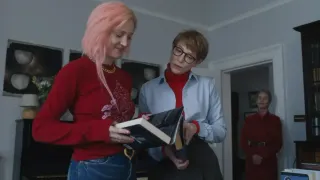
Swedish filmmaker Lasse Hallström's passion for his subject in "Hilma" is certainly obvious. Both his wife, Lena Olin, and their daughter, Tora Hallström (excellent), star in the film as the visionary abstract artist Hilma af Klint. Her personal story was a frustrating and intriguing one, much like Hallström's ambitious film. In her lifetime, Hilma was labeled a witch, constantly turned away by the patriarchal art world, and ridiculed for her desire to understand the connection between the human and spirit worlds. The film casually depicts her same-sex relationships and the drama that ensues. "Hilma's" greatest asset is Olin, seen too fleetingly, in a fully-committed, enigmatic turn. FYI: Research into the paintings of af Klint (she was quite prolific) and/or viewing the doc "Beyond the Visible," will greatly enhanced your enjoyment of this film.
'Girl's Don't Cry' ('Le Ragazze Non Piangono')
Italian filmmaker Andrea Zuliani's dynamic coming-of-age road trip film "Girl's Don't Cry" examines the friendship between two very different young women. 19-year-old Ele (Emma Benini) is unhappy living with her mother in southern Italy and insists on fixing up an old camper and driving it to her late father's best friend's home in the north, where she's always felt more at home. Ele encounters Mia (Anastasia Doaga), a 21-year-old Romanian who is hiding a few dangerous secrets. The two embark on the journey north and begin to bond, but that connection may mean more to one girl than the other, and their odyssey is fraught with untrustworthy men. This is Zuliani's first feature, and he maintains a light tone, even with the few dark clouds that surround the girls. Benini and Doago have great chemistry and keep us enthralled. In Italian and Romanian, with English subtitles.